2026-02-19 ペンシルベニア州立大学(Penn State)
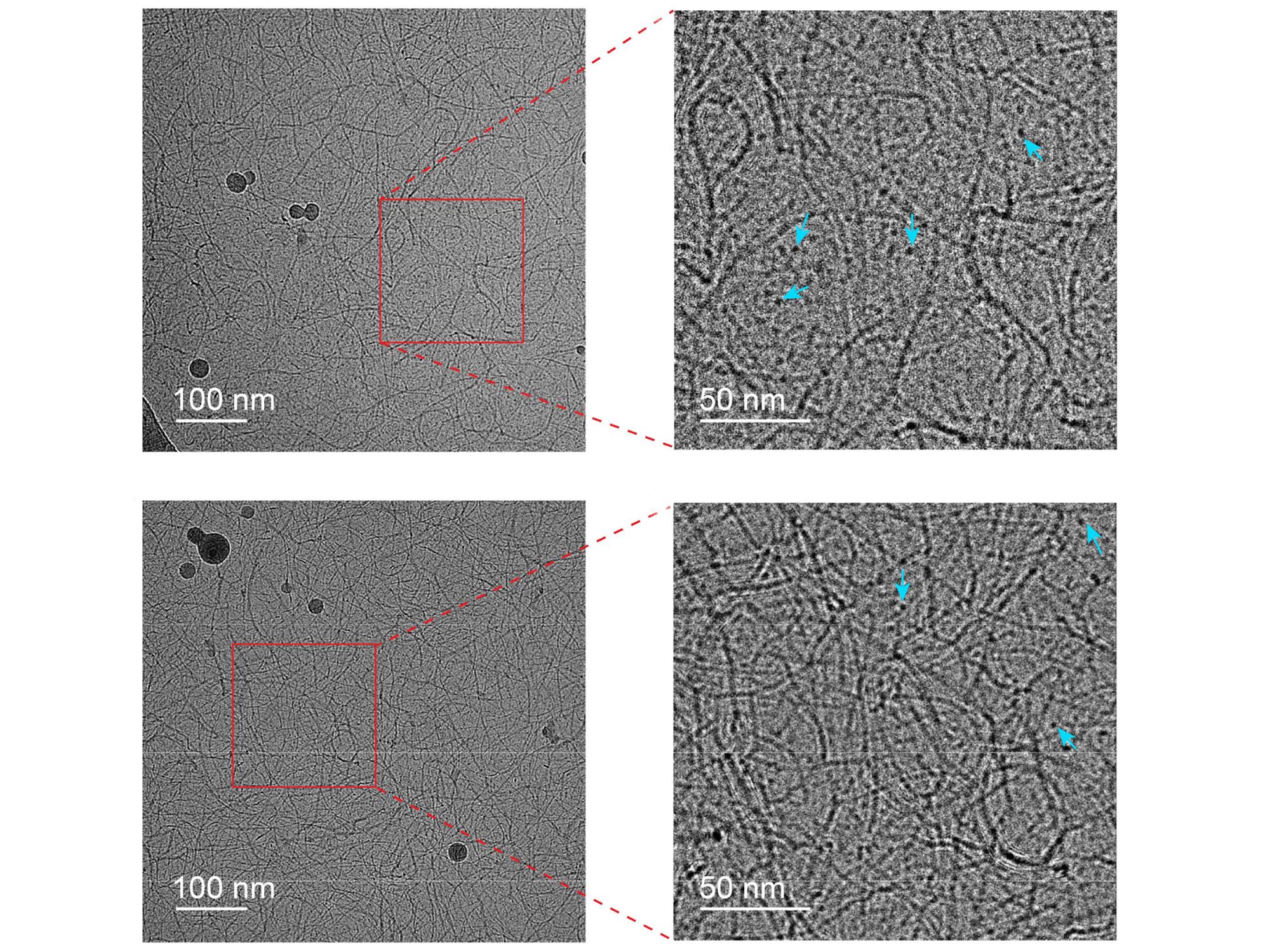
By examining frozen samples of PEDOT:PSS under a cryo-em microscope, the team was able to view the individual whisker-like fibers that enable the material’s conductivity at high resolutions. The team noted how isolated fibers (marked with blue arrows) appeared with varying frequency depending on which salt additives were present in the material. Credit: Provided by Enrique Gomez. All Rights Reserved.
<関連情報>
- https://www.psu.edu/news/research/story/stretchy-plastics-conduct-electricity-tiny-whisker-fibers
- https://www.nature.com/articles/s41467-026-68890-7
極低温透過型電子顕微鏡によりPEDOT:PSSの集合体とナノ構造が明らかに Cryogenic transmission electron microscopy reveals assembly and nanostructure of PEDOT:PSS
Masoud Ghasemi,Louis Y. Kirkley,Farshad Nazari,Mohammed K. R. Aldahdooh,Joshua T. Del Mundo,Dhruv Gamdha,Yi-Chen Lan,Po-Hao Lai,Sung Hyun Cho,Baskar Ganapathysubramanian,Esther W. Gomez & Enrique D. Gomez
Nature Communications Published: 10 February 2026
DOI:https://doi.org/10.1038/s41467-026-68890-7
We are providing an unedited version of this manuscript to give early access to its findings. Before final publication, the manuscript will undergo further editing. Please note there may be errors present which affect the content, and all legal disclaimers apply.
Abstract
Soft and conducting organic materials are ideal candidates for stretchable bioelectronics and wearable devices. Despite recent advances, our understanding of conducting polymer nanostructures and how they arise remains incomplete, given the limited high-resolution studies and molecular-level descriptions of these systems. Here, we employ cryogenic transmission electron microscopy (cryo-EM) to investigate the evolution of poly(3,4-ethylenedioxythiophene):polystyrene sulfonate (PEDOT:PSS) morphology in solution and the resulting solid state structure in the presence of ionic and molecular additives. Our results reveal the formation of heterostructural elongated fibers consisting of PEDOT:PSS micelles in solution. Cryo-EM further reveals that additives increase the number of fibrils, in addition to inducing the formation of crystalline domains. We observe that fibril and crystalline phases in solutions act as a template for the growth of these nanostructures in the solid state. Furthermore, exploiting cryo-EM reveals the role of solid-liquid interactions in PEDOT:PSS through the imaging of PEDOT:PSS nanostructures after the hydration of thin films. Hydration leads to the swelling of heterostructural fibers while reducing the crystalline domain size. Such behavior explains the mechanical robustness of PEDOT:PSS thin films processed with various additives as well as the high electrical conductivity of PEDOT:PSS in applications such as organic electorchemical transistors.