2026-02-20 スイス連邦工科大学ローザンヌ校(EPFL)
<関連情報>
- https://actu.epfl.ch/news/new-ai-algorithm-is-designed-to-obey-the-laws-of-p/
- https://www.nature.com/articles/s41467-025-67802-5
動的システムの線形運動量と角運動量を保存する物理学に基づくグラフニューラルネットワーク A physics-informed graph neural network conserving linear and angular momentum for dynamical systems
Vinay Sharma & Olga Fink
Nature Communications Published:15 January 2026
DOI:https://doi.org/10.1038/s41467-025-67802-5
Abstract
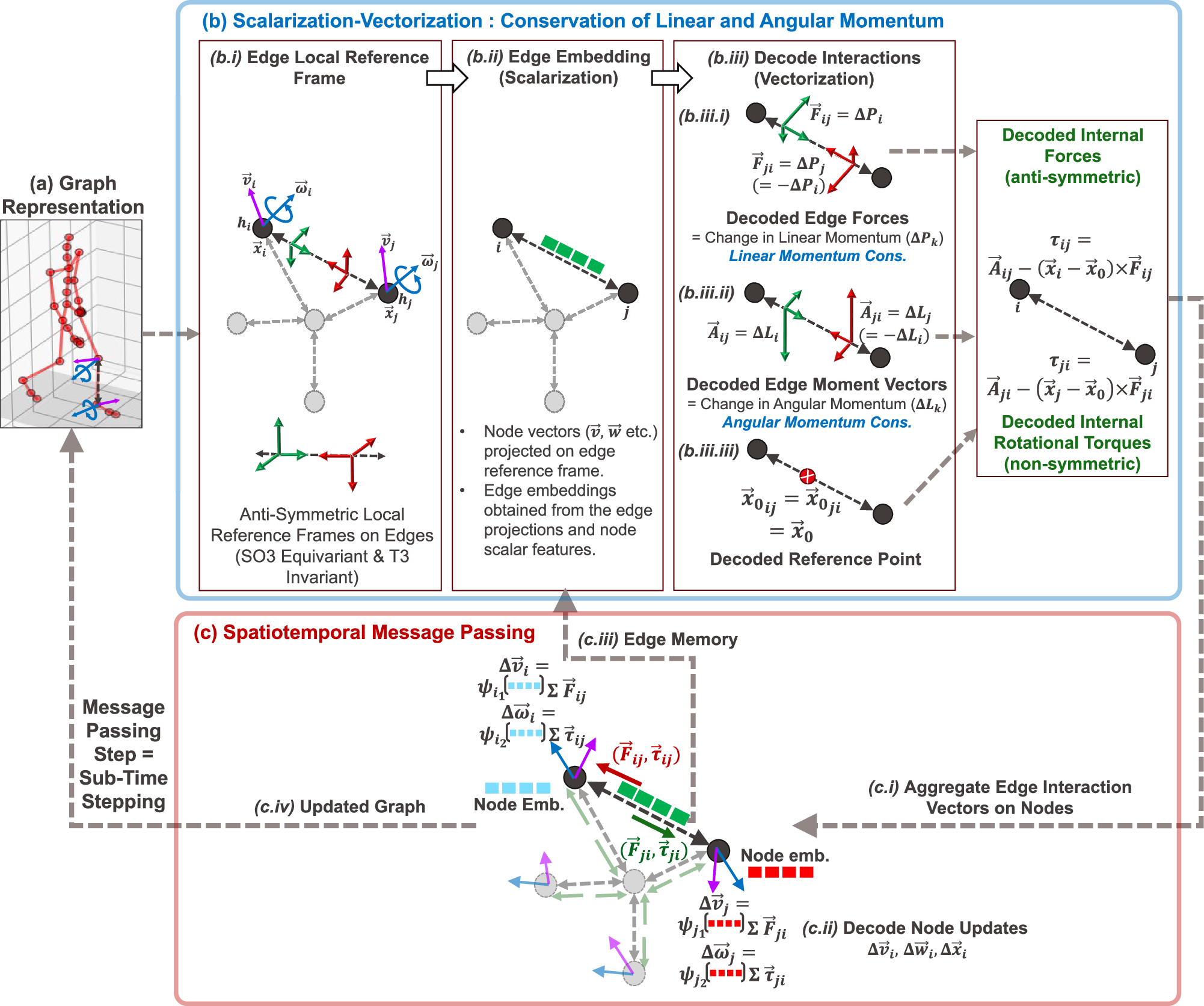
Accurate, interpretable, and real-time modeling of multi-body dynamical systems is essential for predicting behaviors and inferring physical properties in natural and engineered environments. Traditional physics-based models face scalability challenges and are computationally demanding, while data-driven approaches like Graph neural networks (GNNs) often lack physical consistency, interpretability, and generalization. In this paper, we propose DYNAMI-CAL GRAPHNET, a Physics-Informed Graph Neural Network that integrates the learning capabilities of GNNs with physics-based inductive biases to address these limitations. DYNAMI-CAL GRAPHNET enforces pairwise conservation of linear and angular momentum for interacting nodes using edge-local reference frames that are equivariant to rotational symmetries, invariant to translations, and equivariant to node permutations. This design ensures physically consistent predictions of node dynamics while offering interpretable, edge-wise linear and angular impulses resulting from pairwise interactions. Evaluated on a 3D granular system with inelastic collisions, DYNAMI-CAL GRAPHNET demonstrates stable error accumulation over extended rollouts, effective extrapolation to unseen configurations, and robust handling of heterogeneous interactions and external forces. DYNAMI-CAL GRAPHNET offers significant advantages in fields requiring accurate, interpretable, and real-time modeling of complex multi-body dynamical systems, such as robotics, aerospace engineering, and materials science. By providing physically consistent and scalable predictions that adhere to fundamental conservation laws, it enables the inference of forces and moments while efficiently handling heterogeneous interactions and external forces. This makes it invaluable for designing control systems, optimizing mechanical processes, and analyzing dynamic behaviors in both natural and engineered systems.