2026-02-20 北海道大学
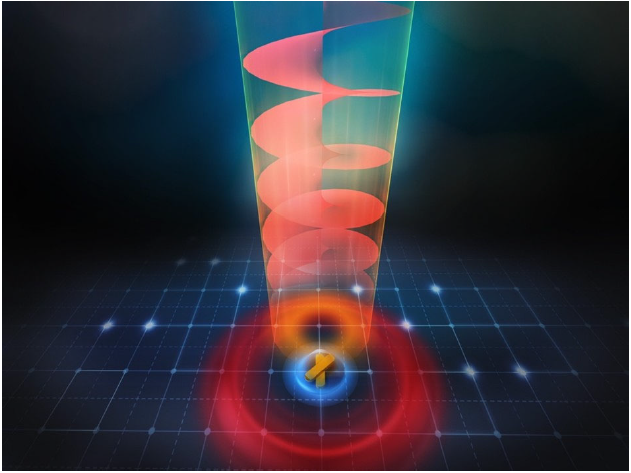
光渦が持つ空間的なねじれと物質の立体的なねじれが結びつくことで、暗い中心付近にキラリティ由来の左右差が現れる原理を示した概念図。
<関連情報>
- https://www.hokudai.ac.jp/news/2026/02/post-2193.html
- https://www.hokudai.ac.jp/news/pdf/260220_pr3.pdf
- https://opg.optica.org/optica/fulltext.cfm?uri=optica-13-2-353
多重極子のキラリティとの相互作用により顕在化した光の軌道角運動量に基づくキラリティ Unveiling orbital optical chirality through multipolar chiral light–matter interaction
Shun Hashiyada, An’an Wu, and Yoshito Y. Tanaka
Optica Published: February 17, 2026
DOI:https://doi.org/10.1364/OPTICA.584008
Abstract
Chiral light–matter interactions are central to optical spectroscopy and nanophotonics, yet they are conventionally understood as arising from electric–magnetic dipolar interference driven by light with spin angular momentum. Here, we show that optical chirality can also originate from the orbital angular momentum (OAM) of light, enabling chiral responses mediated by higher-order multipolar interactions. Using a single twisted gold nanorod dimer as a minimal chiral platform, we perform spatially and spectrally resolved measurements of chiral dichroism under tightly focused circularly polarized optical vortex beams carrying spin and orbital angular momenta of the same sign. We observe qualitatively distinct chiral responses at the vortex center and in the annular region of the beam. In particular, OAM-sign-dependent quadrupolar resonances emerge at the beam center, where conventional spin-induced optical chirality vanishes. Reciprocity tests and angular momentum dissipation analysis confirm that this response is a genuine chiral interaction dominated by orbital, rather than spin, angular momentum. These results establish the existence of a distinct form of optical chirality, referred to as orbital optical chirality, and open opportunities for probing multipolar chiral light–matter interactions beyond the dipolar paradigm.