
2026-02-20 ロイヤルメルボルン工科大学(RMIT)
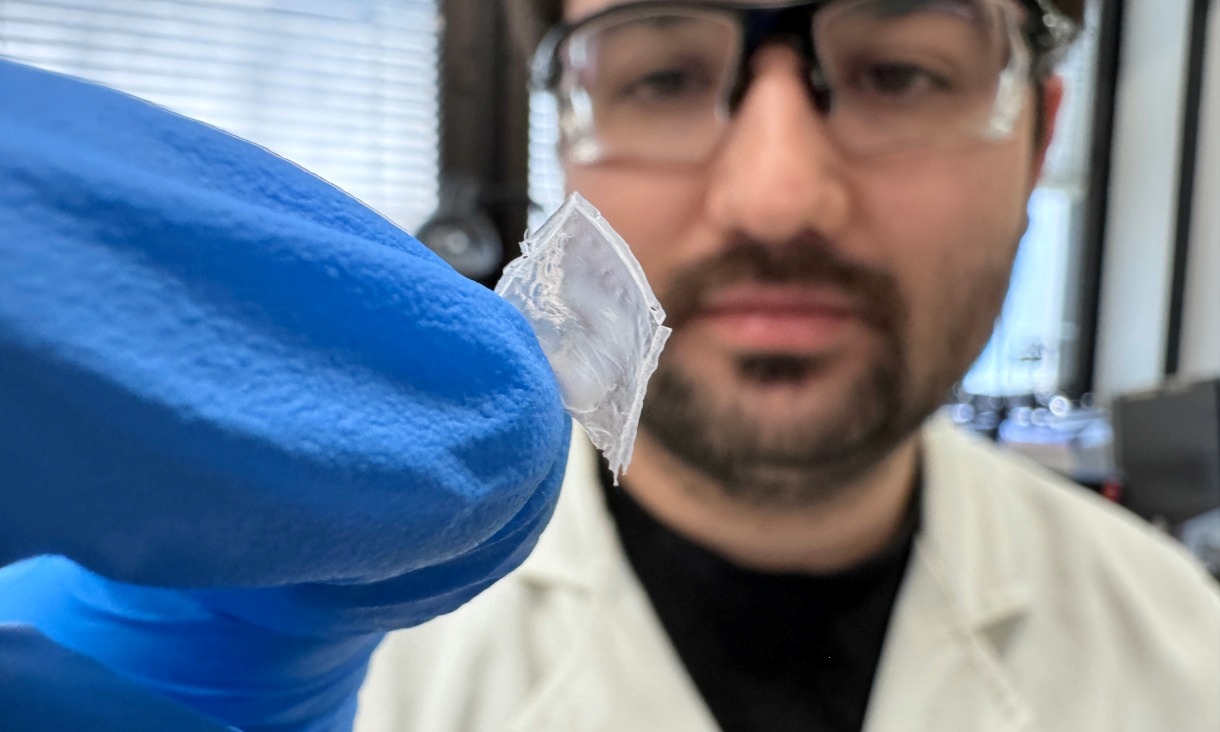
PhD researcher Robert Komljenovic holds the tough and flexible nylon film developed at RMIT University that generates electricity when bent, pressed or compressed. Credit: Will Wright, RMIT University
<関連情報>
- https://www.rmit.edu.au/news/all-news/2026/feb/tough-flexible-self-powered-sensor
- https://www.nature.com/articles/s41467-025-66389-1
堅牢で高圧電性のナイロン11フィルムの電気音響配向 Electroacoustic alignment of robust and highly piezoelectric nylon-11 films
Robert Komljenovic,Yemima Ehrnst,Peter C. Sherrell,Amgad R. Rezk & Leslie Y. Yeo
Nature Communications Published:29 January 2026
DOI:https://doi.org/10.1038/s41467-025-66389-1
Abstract
Nylon-11—a common and widely used material, is a promising non-fluorinated piezoelectric polymer given its mechanical strength, chemical stability and elasticity. Nevertheless, it typically possesses low piezoelectric performance, which severely limits its use for energy generation applications. Here, we demonstrate the synthesis of highly aligned, piezoelectric nylon-11 films through an energy-efficient (≈1–5 Wh), single-step platform that facilitates the electroacoustic coupling associated with MHz-order nanoscale vibrations during the crystallisation process. Uniquely, such coupling allows the simultaneous induction of (i) nylon’s piezoelectric -phase, (ii) long-range crystalline ordering, (iii) an ordered hydrogen-bonded network, and (iv) dipole alignment, which we directly probe using time-resolved operando synchrotron grazing-incidence wide-angle X-ray scattering and high-resolution infrared spectroscopy. We show that the material produces a piezoelectric voltage coefficient (g33 = 427 × 10−3 Vm N−1) that surpasses the performance of all piezoelectric polymers reported to date. The film’s exceptional mechanical resilience is evident from its stable performance over 20,000 compression cycles at 50 N and its ability to withstand vehicular loads.


