2026-02-18 海洋研究開発機構,国立極地研究所,気象庁気象研究所
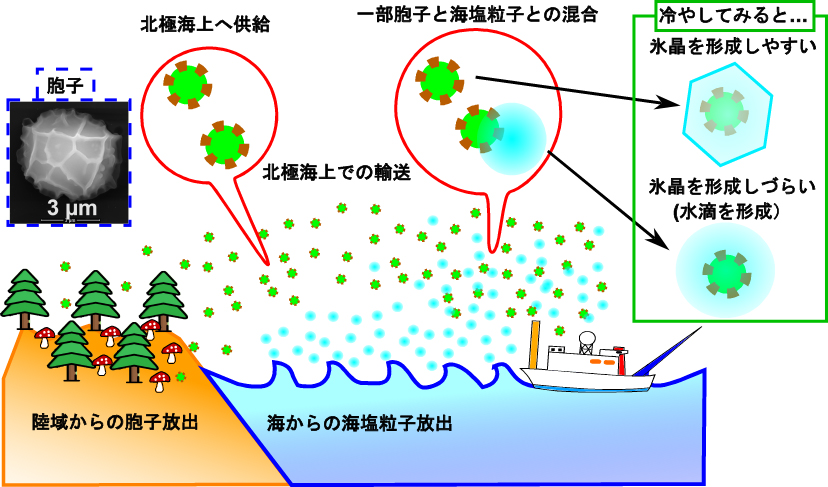
図1 本研究で観測した、陸域から北極海上への胞子の供給、輸送過程で起こる海塩粒子との混合と、氷晶核としての機能の変化を表した概念図。
<関連情報>
- https://www.jamstec.go.jp/j/about/press_release/20260218_3/
- https://www.nature.com/articles/s41612-025-01291-7
北極海上の氷核粒子への陸上生態系由来のバイオエアロゾルの寄与 Contribution of bioaerosols from terrestrial ecosystems to ice-nucleating particles over the Arctic Ocean
Takeshi Kinase,Fumikazu Taketani,Yutaka Tobo,Masayuki Takigawa,Kouji Adachi,Takuma Miyakawa,Chunmao Zhu & Yugo Kanaya
npj Climate and Atmospheric Science
Abstract
Aerosols act as ice nucleating particles (INPs) in mixed-phase clouds and cause uncertainties in climate prediction of the Arctic, which is warming faster than the global average. Primary biological aerosols (PBAs) are important INPs; however, their spatiotemporal variability, sources, and ice nucleation microphysics remain poorly understood. Here, we performed microscopic analysis, online and offline observations, and model simulations to investigate ambient aerosol particles related to INPs collected during the R/V Mirai Arctic cruise in 2022. We found that PBAs, particularly spores, were transported from terrestrial sources in Alaska and Canada to the Arctic Ocean and contributed to elevated INP concentrations. In addition, the ice-nucleating efficiency of PBAs was suppressed when fresh sea salt attached to or coated INPs. This study reveals an additional source of INPs over the Arctic Ocean, highlights the importance of alterations in INP mixing state during transport. These findings improve understanding of PBA contributions to Arctic cloud formation and their implications for climate feedbacks.