
2026-02-12 コロンビア大学
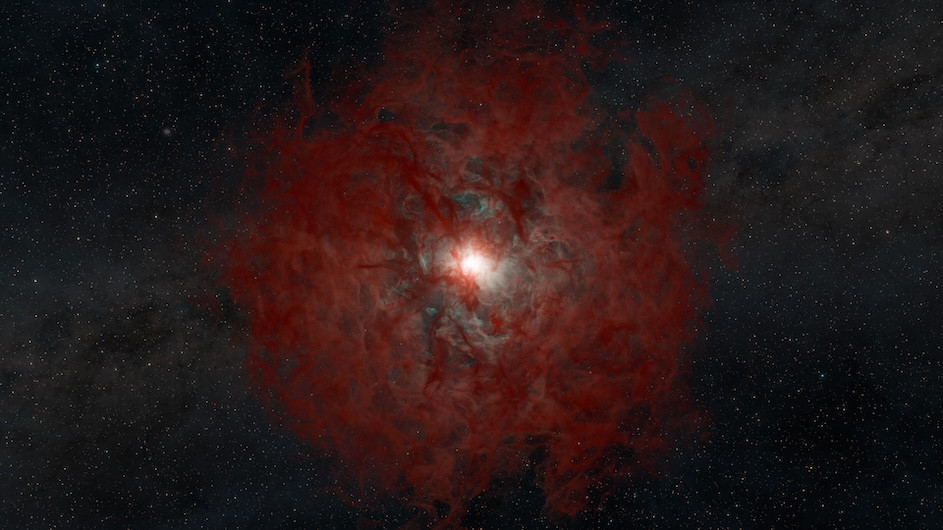
The image shows a shell of thick gas and dust (red) expelled from the outer layers of a star as its core collapsed into a black hole. The inner regions show a heated ball of gas (white) continuing to fall into the central black hole. (Credit: Keith Miller, Caltech/IPAC – SELab)
<関連情報>
- https://news.columbia.edu/news/scientists-capture-clearest-view-yet-star-collapsing-black-hole
- https://www.science.org/doi/10.1126/science.adt4853
ブラックホールの形成によるアンドロメダ銀河の巨大な星の消失 Disappearance of a massive star in the Andromeda Galaxy due to formation of a black hole
Kishalay De, Morgan MacLeod, Jacob E. Jencson, Elizabeth Lovegrove, […] , and Robert Simcoe
Science Published:12 Feb 2026
DOI:https://doi.org/10.1126/science.adt4853
Editor’s summary
In a dying massive star, the core collapses to form a compact object. Simultaneously, the outer layers can be ejected at high speed, which is observed as a supernova. Theory predicts that sometimes the ejection speed is too low to escape the gravitational field, so the outer layers fall back over several years, producing no supernova and a more massive compact object. De et al. have identified a supergiant star in the nearby Andromeda Galaxy that brightened in the infrared then decreased in optical brightness over the next few years until it became undetectable. They attribute this behavior to a failed supernova and the formation of a black hole. —Keith T. Smith
Abstract
When a massive star reaches the end of its lifetime, its core collapses and releases neutrinos that drive a shock into the outer layers (the stellar envelope). A sufficiently strong shock ejects the envelope, producing a supernova. If the shock fails to eject it, the envelope is predicted to fall back onto the collapsing core, producing a stellar-mass black hole (BH) and causing the star to disappear. We report observations of M31-2014-DS1, a hydrogen-depleted supergiant in the Andromeda Galaxy. In 2014, it brightened in the mid-infrared, then from 2017 to 2022, it faded by factors of ≳104 in optical light (becoming undetectable) ≳ 10and in total light. We interpret these observations, and those of a previous event in NGC 6946, as evidence for failed supernovae forming stellar-mass BHs.


