2026-02-09 東北大学
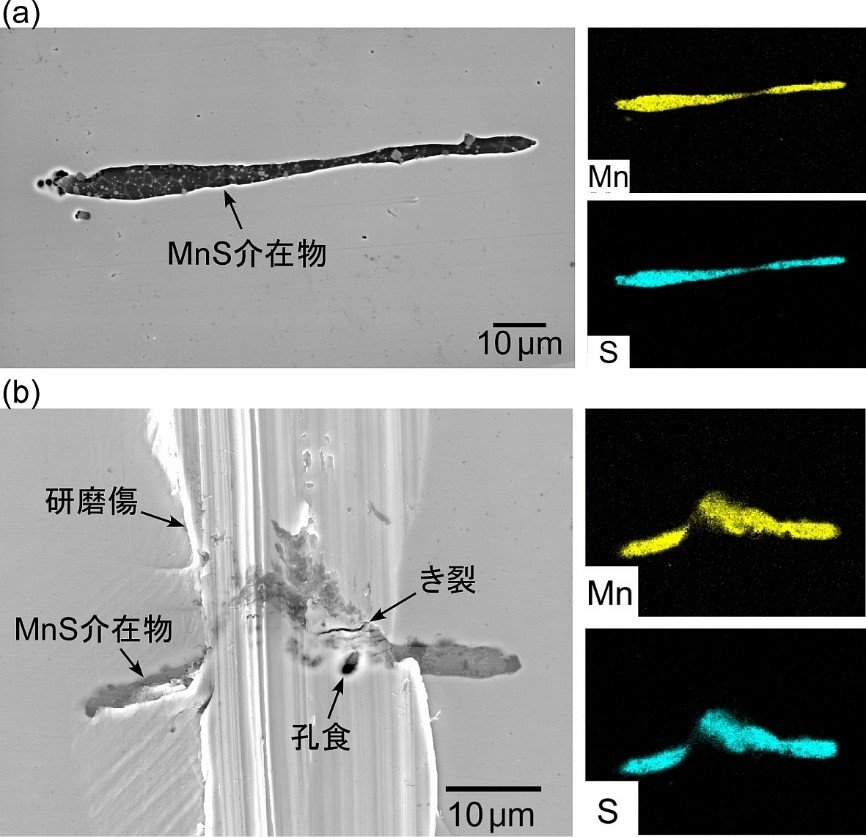
図1. (a)平滑なステンレス鋼表面のMnS介在物の走査型電子顕微鏡写真およびエネルギー分散型X線分光法による元素マップ。(b)粗い機械研磨を施したステンレス鋼表面に存在するMnS介在物の走査型電子顕微鏡写真および元素マップ。研磨によりMnS介在物が変形し、一部にき裂や鋼中への埋没が見られる。また、研磨傷とMnS介在物が交差する箇所において孔食が観察されている。
<関連情報>
- https://www.tohoku.ac.jp/japanese/2026/02/press20260209-02-MnS.html
- https://www.tohoku.ac.jp/japanese/newimg/pressimg/tohokuuniv-press20260209_02web_MnS.pdf
- https://www.nature.com/articles/s41529-026-00750-7
ステンレス鋼の耐孔食性における研削による劣化:不動態皮膜とMnSに関する知見 Grinding-induced degradation in the pitting corrosion resistance of stainless steel: insights into passive film and MnS
Siqi Wang,Masashi Nishimoto & Izumi Muto
npj Materials Degradation Published:04 February 2026
DOI:https://doi.org/10.1038/s41529-026-00750-7 An unedited version of this manuscript
Abstract
This study investigates the effect of surface grinding on the pitting corrosion resistance of high-S and low-S Type 304 stainless steels. Microelectrochemical analysis reveals that MnS inclusions serve as the initiation sites for pitting, whereas no pitting occurs in MnS-free regions. Severe grinding with #60 SiC paper significantly reduces the pitting potential, whereas moderate grinding with #320 SiC paper produces only a negligible change. The reduction in pitting corrosion resistance is attributed to grinding-induced alterations in MnS morphology, including deformation and embedding. In contrast, moderate grinding (#320 SiC paper) does not significantly alter MnS morphology and therefore preserves pitting corrosion resistance comparable to that of mirror-polishing surfaces. Grinding introduced unevenness of passive film thickness, and the intersections between MnS inclusions and scratches act as preferential pit initiation sites. However, the decrease in protective capability of the passive films alone does not fully account for the observed decrease in pitting potential following severe grinding.