2026-2-09 中国科学院(CAS)
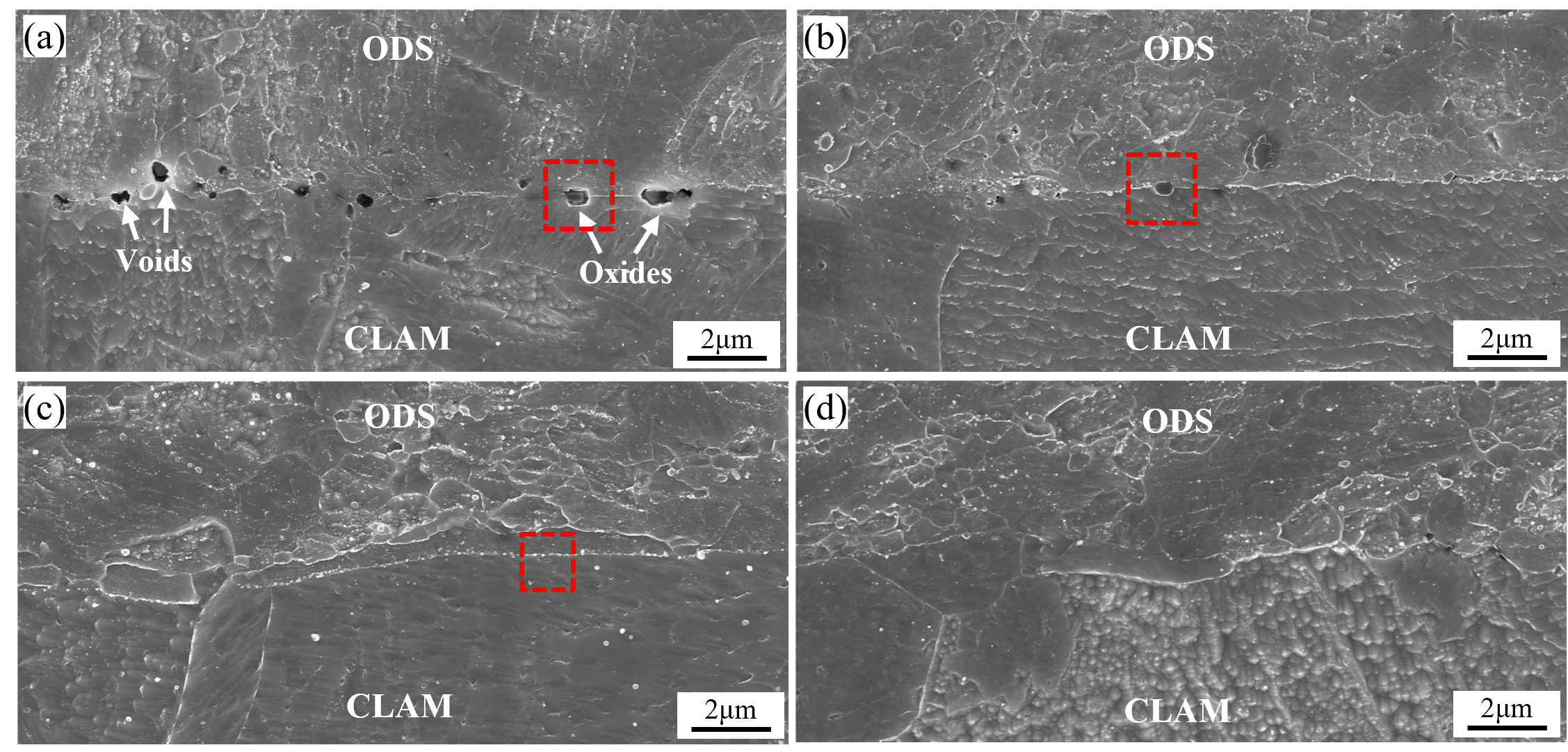
Interfacial microstructures near the interface compressed at 1,050 °C with different deformations: (a) 5%, (b) 10%, (c) 30%, (d) 50%. (Image by BAI Yunfei)
<関連情報>
- https://english.cas.cn/newsroom/research-news/202602/t20260210_1150470.shtml
- https://www.sciencedirect.com/science/article/abs/pii/S1044580325009271
CLAM鋼と9Cr-ODS合金の熱間圧縮接合における変形が界面微細構造と酸化物に及ぼす影響 Effect of deformation on interfacial microstructure and oxides for hot-compression bonding of CLAM steel and 9Cr-ODS alloy
Yunfei Bai, Jianqiang Wang, Gaofan Zhu, Honglin Zhang, Bin Xu, Takuya Nagasaka, Qunying Huang, Mingyue Sun
Materials Characterization Available online: 9 October 2025
DOI:https://doi.org/10.1016/j.matchar.2025.115638
Highlights
- The evolution of interfacial oxides of CLAM/9Cr-ODS joint was characterized.
- The core TiTaO4 and shell Y2TiO5 oxides were formed near the interface.
- The interfacial bonding mechanism of CLAM/9Cr-ODS joint was investigated in depth.
- Interfacial oxides transformed to Y-Ti-O nano-oxides with deformation increasing.
Abstract
Both the China low activation martensitic (CLAM) steel and oxide dispersion strengthened (ODS) alloy showed high potential applications in nuclear reactor system. In this study, the hot compression bonding (HCB) for CLAM steel and 9Cr-ODS alloy was carried out at the temperature 1050 °C and the strain rate 0.01 s−1 with different deformations among 5 % and 50 %. The results indicated that the interfacial oxides of HCBed CLAM and 9Cr-ODS samples underwent remarkable transformation with increasing deformation. There were a number of oxides larger than 500 nm enriched with Cr, Mn and Ti elements remained at the bonding interface of the sample with 5 % deformation. Under 10 % deformation, Cr- and Mn-rich oxides basically decomposed, and the interfacial oxides transformed into TiTaO4 and a small amount of Y2TiO5 with the average size of ∼200 nm. In addition, some nano-oxides with sizes smaller than 30 nm presented near the interface, which were mainly irregular TiTaO4 oxides and spherical Y2O3 and Y-Ti-O oxides. When the deformation increasing to 30 %, most interfacial oxides transformed into compound oxides with a core of TiTaO4 and a shell of Y2TiO5, and their sizes reduced to less than 100 nm. Moreover, there were Y-Ti-O nano-oxides near the interface, which were comparable to the nanoparticles in the 9Cr-ODS matrix. As deformation reached 50 %, the large-size interfacial oxides were converted to nano-oxides completely and the original flat bonding interface were replaced by dynamic recrystallized grains, the interface could complete the healing. Evolution of interfacial oxides and dynamic recrystallization promoted the interface healing of two dissimilar alloys. The performance evaluation on the bonding interface and corresponding fracture morphology analysis showed that tensile properties of HCBed dissimilar joints at 10 % deformation were comparable with CLAM steel. This study is expected to promote the future application of complex blanket structures for fusion reactor.