2026-02-05 カリフォルニア工科大学(Caltech)

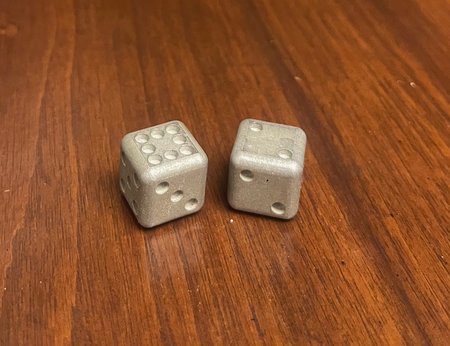
A pair of “crazy,” or Sicherman, dice, invented in 1977 by puzzle creator and math enthusiast Col. George Sicherman.
Credit: Caltech/Whitney Clavin
<関連情報>
- https://www.caltech.edu/about/news/economics-puzzle-leads-to-a-new-understanding-of-a-fundamental-law-of-physics
- https://link.springer.com/article/10.1007/s00208-025-03263-x
ボルツマン分布の起源について On the origin of the Boltzmann distribution
Fedor Sandomirskiy & Omer Tamuz
Mathematische Annalen Published:17 August 2025
DOI:https://doi.org/10.1007/s00208-025-03263-x
Abstract
Boltzmann distributions are used in statistical mechanics to describe how the states of a system are distributed at a given temperature. We give a novel characterization of this family as the unique one satisfying independence for uncoupled systems. The theorem boils down to a statement about endomorphisms of the convolution semi-group of finitely supported probability measures on the natural numbers, or, alternatively, about endomorphisms of the multiplicative semi-group of polynomials with non-negative coefficients.