2026-01-30 東京大学
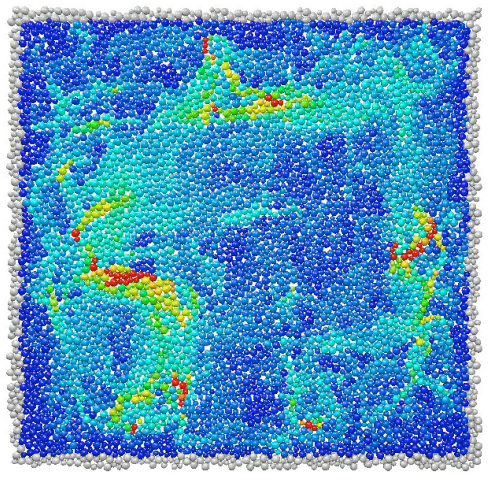
摩擦のある粒子の振動下での運動の様子
<関連情報>
- https://www.rcast.u-tokyo.ac.jp/ja/news/release/20260130.html
- https://www.pnas.org/doi/10.1073/pnas.2528600123
粒状材料における摩擦制御リエントラント老化と流動化 Friction-controlled reentrant aging and fluidization in granular materials
Ye Yuan, Walter Kob, and Hajime Tanaka
Proceedings of the National Academy of Sciences Published:January 27, 2026
DOI:https://doi.org/10.1073/pnas.2528600123
Significance
When a bag of coffee beans is gently tapped, the grains settle into a denser arrangement, yet vigorous shaking makes them looser. Such everyday compaction conceals rich nonequilibrium physics governed by frictional interactions between particles. Using numerical simulations, we show that friction controls how granular materials—such as grains, powders, and soils—become compacted and flow under cyclic shear. Increasing friction first stabilizes the packing and slows down relaxation, but eventually promotes creep-like motion that refluidizes the system and reduces density. This reentrant transition reveals the dual stabilizing and fluidizing roles of friction, linking microscopic particle interactions to macroscopic rheology, uncovering universal principles of aging and flow in disordered, athermal matter.
Abstract
Granular materials densify under repeated mechanical perturbations, nonequilibrium dynamics that underlies many natural and industrial processes. Because granular relaxation is governed by frictional contacts and energy dissipation, this aging behavior fundamentally differs from that of thermal glasses despite their apparent similarities. Here, we uncover how friction controls the compaction dynamics of granular packings subjected to quasistatic cyclic shear. Using discrete element simulations, we construct a dynamic state diagram as a function of strain amplitude and friction, revealing a rich interplay among jamming marginality, stabilization, and fluidization. We identify a friction-dependent crossover strain that separates aging and fluidized regimes, showing reentrant, nonmonotonic behavior: Increasing friction first suppresses fluidization but then promotes it through smooth, creep-like rearrangements. This transition is marked by a shift from intermittent, avalanche-like rearrangements to continuous, diffusive motion. Our findings demonstrate that friction exerts a dual role in granular aging—both stabilizing and fluidizing—thereby uncovering the fundamental nonequilibrium mechanisms that govern compaction, rheology, and aging in athermal disordered systems. More broadly, our results reveal a general principle for how friction governs metastability and flow in athermal matter—from granular and frictional colloids to soils and seismic faults—linking microscopic contact mechanics to macroscopic dynamics.