
2026-01-29 東北大学
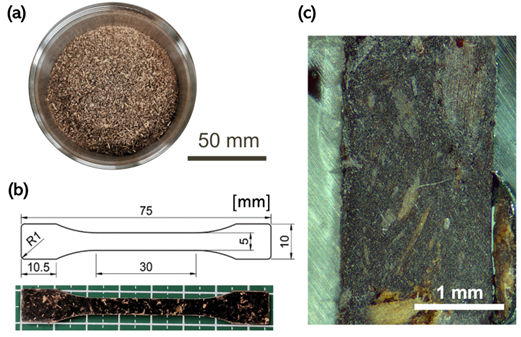
図1. 樹皮−PBS複合材料の作製と構造。(a)粉砕した複合材料ペレットの外観、(b)引張試験に用いたダンベル形試験片の寸法および試験片外観、(c)作製した複合材料断面のデジタル顕微鏡像。
<関連情報>
- https://www.tohoku.ac.jp/japanese/2026/01/press20260129-01-bark.html
- https://www.tohoku.ac.jp/japanese/newimg/pressimg/tohokuuniv-press20260129_01web_bark.pdf
- https://www.nature.com/articles/s41529-026-00740-9
樹皮をベースとしたグリーン複合材料の引張特性による生分解性の評価と解釈 Evaluating and interpreting biodegradability of a tree bark–based green composite through tensile properties
Lovisa Rova,Zhenjin Wang,Hiroki Kurita & Fumio Narita
npj Materials Degradation Published:20 January 2026
DOI:https://doi.org/10.1038/s41529-026-00740-9 An unedited version of this manuscript
Abstract
This study is about the fabrication and evaluation of a new green composite made from the tree bark of the Yakushima Jisugi tree and polybutylene succinate (PBS) polymer. The tensile properties and biodegradability of the composite were evaluated, including a 6-month-long soil burial test. The tensile strength of the composite was not as high as that of neat PBS since the bark content was high at 60 wt.%. In compost, the composite degraded by about 13% in 8 weeks. The composite also displayed biodegradability in outdoor soil, which was evaluated by measuring changes in tensile and thermal properties. The tensile modulus, strength, and elongation at break deteriorated, and the melting point decreased as soil burial progressed, eventually reaching a melting point 2 °C lower than the as-fabricated specimen after 30 weeks of burial. Furthermore, by combining the tensile data from the biodegradation experiments in compost and soil, it was estimated that the composite degraded by about 5% during 30 weeks of soil burial. A theoretical framework based on random chain-scission kinetics was introduced to rationalize the experimentally observed exponential relationship between increased degree of biodegradation and decrease in tensile strength, providing a description of tensile strength deterioration as a function of material degradation. Due to the material’s excellent biodegradability, it has potential applications in agriculture and as a component in time-programmed devices that self-disintegrate after being discarded. In addition, partial discharge testing revealed that the composite exhibited sufficient initial dielectric strength, further supporting its potential for transient applications such as biodegradable sensors or disposable electronic packaging.


](https://tiisys.com/wp-content/uploads/2026/01/スクリーンショット-2026-01-29-170349.png "法人所属 イームズロボティクスUAV-E6150FA(無人航空機、マルチローター)の事故[無人航空機による人の死傷(重傷)](福島県南相馬市、令和6年6月21日発生)")