2026-01-28 ペンシルベニア州立大学(Penn State)
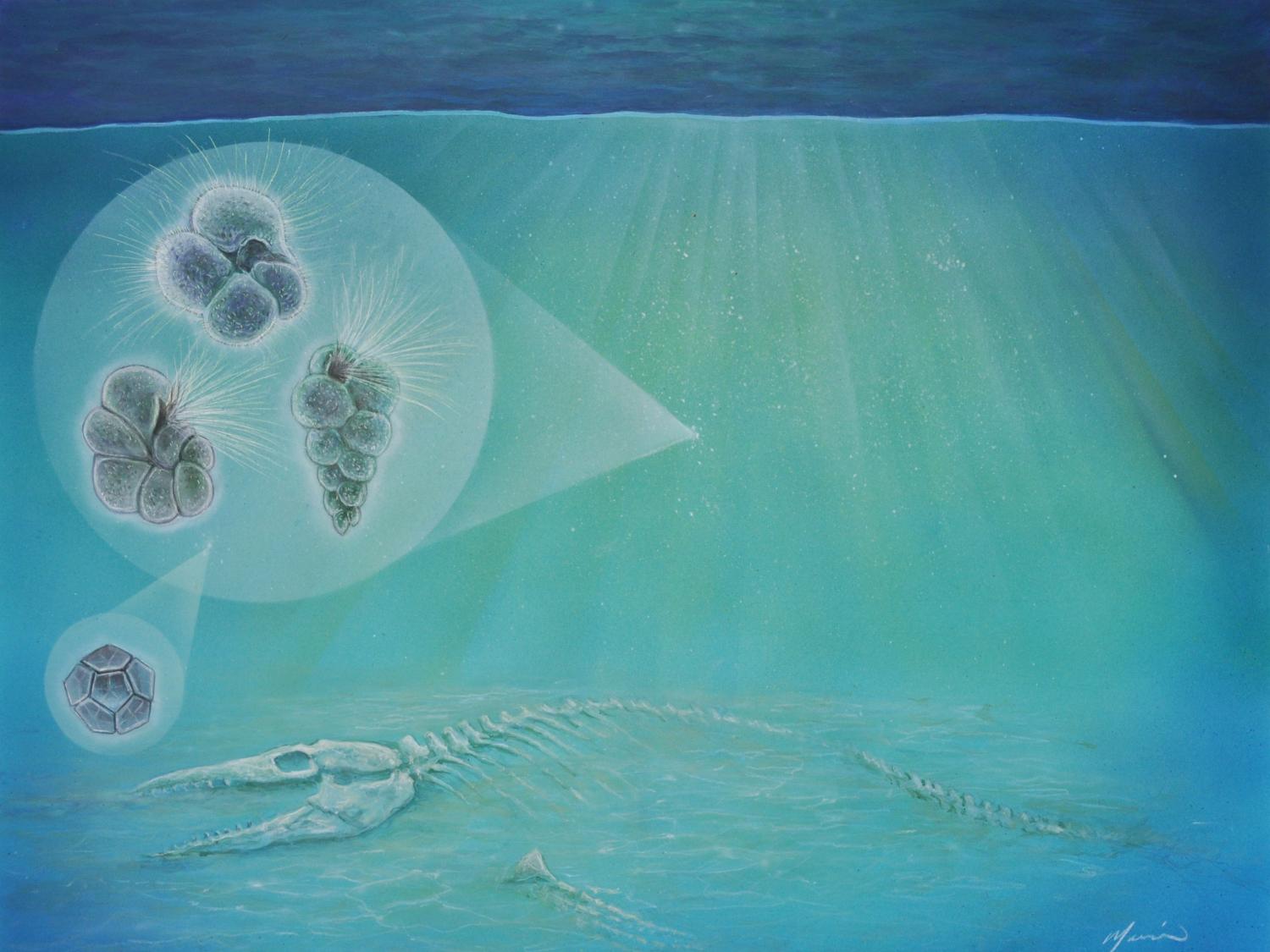
An artist’s interpretation of life and death after the asteroid impact that wiped out the dinosaurs. The three hair-covered forms, left, represent species of plankton found inside the crater made by the impact. The geometric form, on the bottom left, is a species of algae. The bones belong to an extinct marine reptile. Credit: Provided by the University of Texas at Austin Jackson School of Geosciences/John Maisano. All Rights Reserved.
<関連情報>
- https://www.psu.edu/news/earth-and-mineral-sciences/story/new-species-emerged-faster-thought-after-dinosaur-extinction-study
- https://pubs.geoscienceworld.org/gsa/geology/article-abstract/doi/10.1130/G53313.1/724558/New-species-evolved-within-a-few-thousand-years-of
チクシュルーブ隕石衝突から数千年以内に新しい種が進化した
New species evolved within a few thousand years of the Chicxulub Impact
Christopher M. Lowery;Timothy J. Bralower;Kenneth Farley;R. Mark Leckie
Geology Published:January 21, 2026
DOI:https://doi.org/10.1130/G53313.1
The immediate aftermath of the Cretaceous/Paleogene (K/Pg) mass extinction (ca. 66 Ma) in the marine realm was characterized by the initial recovery of productivity and the originations of new species. These major events are recorded in sediments a few centimeters above the K/Pg boundary and are typically dated via planktic foraminiferal biostratigraphy. The first Paleocene planktic foraminifer biozone is Zone P0, defined as the interval between the extinction of Cretaceous species and the first appearance of the new Paleocene taxon Parvularugoglobigerina eugubina. Constraining the age of the top of the global Biochron P0 is crucial for understanding how quickly this initial diversification occurred. However, the long-accepted value, ∼30 k.y. after the boundary, is based on the assumption of constant sedimentation rates across the K/Pg boundary. We provide a new calibration for this important biostratigraphic marker using published records of 3He, a proxy for instantaneous sedimentation rates, from six K/Pg boundary sites. We find Biochron P0 durations between 3.5 k.y. and 11.1 k.y., with an average of 6.4 k.y. Taxonomic concepts vary among researchers, but as many as 10 new species of planktic foraminifera have been observed within Zone P0, with many more reported at or just above its top. Based on our new calibration, the first of these new species appeared <2 k.y. after the Chicxulub impact. The ages and order of these first appearances vary slightly from site to site, suggesting biogeographic differences between sites as novel taxa evolved and dispersed.