2026-01-23 東京科学大学
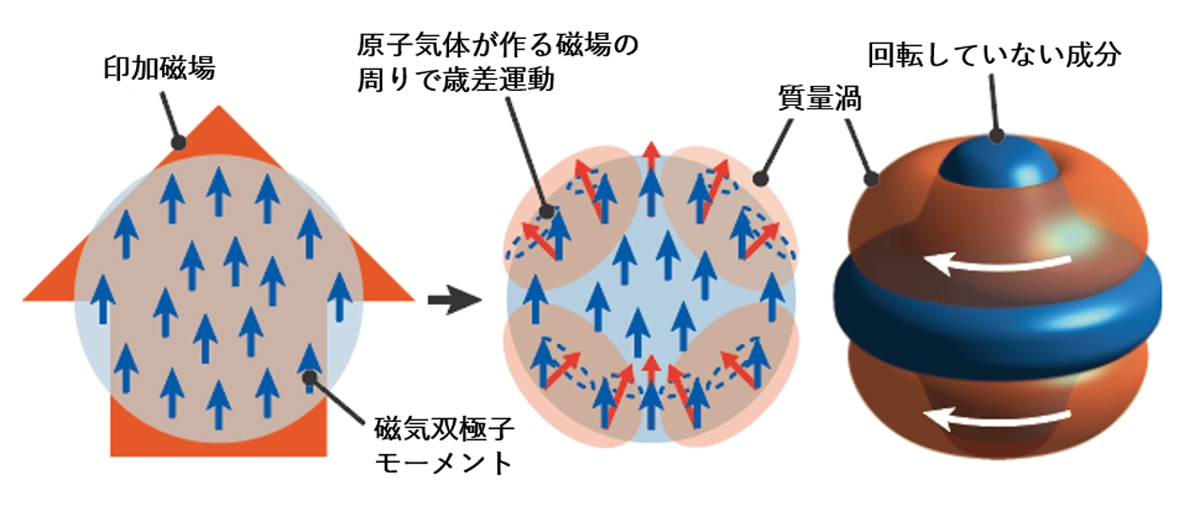
図1. ボース=アインシュタイン凝縮をした磁性量子気体中でスピンから回転運動に角運動量が移行する様子。印加磁場に沿ってスピンが配向した磁性量子気体をゼロ磁場中に置くと、気体自体が生成する磁場の周りでスピンが歳差運動をするが、その際、全角運動量を保存するために質量渦が発生する。
<関連情報>
ボース=アインシュタイン凝縮体におけるアインシュタイン=ド・ハース効果の観測 Observation of the Einstein–de Haas effect in a Bose–Einstein condensate
Hiroki Matsui, Yuki Miyazawa, Ryoto Goto, Chihiro Nakano, […] , and Mikio Kozuma
Science Published:22 Jan 2026
DOI:https://doi.org/10.1126/science.adx2872
Editor’s summary
Spins of electrons in atoms and macroscopic rotating bodies both have angular momentum, which can be exchanged between the two. This exchange forms the basis of the Einstein—de Haas effect, in which a ferromagnet’s rotational speed changes in response to a change in its magnetization. Observing this effect in its coherent form is more challenging. Matsui et al. used an optically confined Bose-Einstein condensate of europium atoms, which have a high magnetic dipole moment, to search for the evidence of this exchange. After the atoms were transferred from the highest to lower spin states, the researchers observed the formation of vortices, signifying the exchange of angular momentum between atomic spins and the rotation of the quantum fluid. —Jelena Stajic
Abstract
The Einstein–de Haas effect is a phenomenon in which angular momentum is transferred from microscopic spins to mechanical rotation of a macroscopic rigid body. We report an observation of the Einstein–de Haas effect in a spinor-dipolar Bose–Einstein condensate, in which the intrinsic magnetic dipole-dipole interaction mediates coherent transfer of angular momentum from atomic spins to collective circulation of a quantum fluid. The depolarized spinor components displayed ring-shaped density distributions that were confirmed as quantized vortices through matter-wave interferometry, revealing a coherent conversion between spin and orbital angular momentum. This observation opens a pathway to exploring ground-state phases with broken chiral symmetry, spin textures, and mass circulation, as well as the Barnett effect in dipolar quantum gases.