2026-01-22 ジョンズ・ホプキンス大学(JHU)
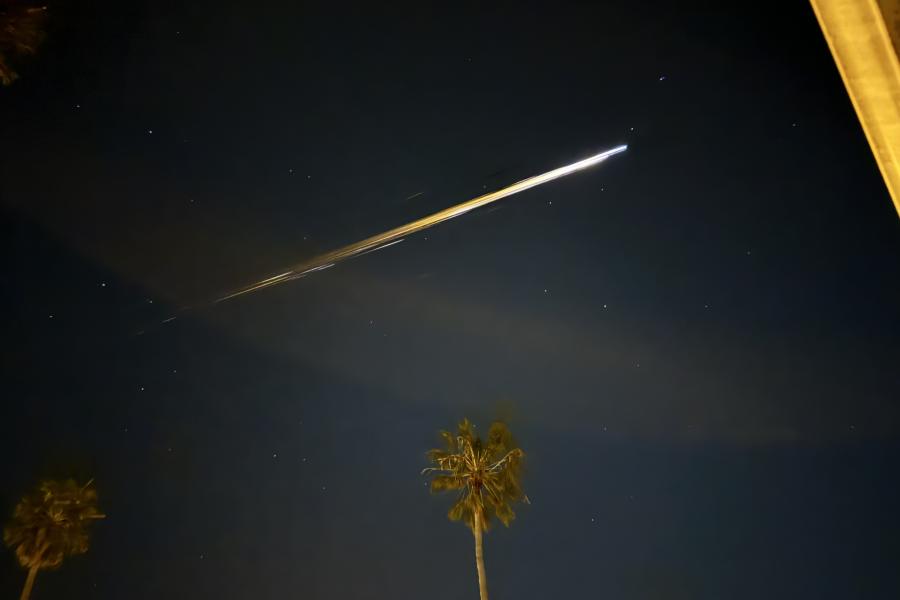
Shenzhou-15 spacecraft debris entering Earth’s atmosphere, April 2, 2024.Credit:Christopher H. / American Meteor Society
<関連情報>
- https://hub.jhu.edu/2026/01/22/tracking-falling-space-debris/
- https://www.science.org/doi/10.1126/science.adz4676
地震データを用いて追跡された宇宙デブリの再突入と崩壊のダイナミクス Reentry and disintegration dynamics of space debris tracked using seismic data
Benjamin Fernando and Constantinos Charalambous
Science Published:22 Jan 2026
DOI:https://doi.org/10.1126/science.adz4676
Editor’s summary
More and more spacecraft are falling back to Earth. Radar and optical limits mean that uncontrolled re-entries are difficult to track and, in case of toxic fallout, quickly mitigate. Fernando and Charalambous tapped open-source seismic data to demonstrate how a sensor network resolved the shockwaves caused by the 2024 re-entry and breakup of the Shenzhou-15 module over Southern California (see the Perspective by Carr). Their inversion technique yielded critical information about the debris, including speed, trajectory, descent angle, and fragmentation pattern. The combination of publicly available data and a computationally efficient analysis shows the promise of near real-time seismic tracking of re-entering space debris. —Angela Hessler
Abstract
The risks posed by reentering space debris continue to grow as Earth’s orbit becomes more crowded. Currently, responses to uncontrolled reentries are hampered by an inability to reliably track spacecraft once they are burning up within the atmosphere, meaning that debris fallout locations are poorly predicted. We have demonstrated a minimum-gradient fit seismic inversion methodology that allows in-atmosphere debris trajectory, speed, altitude, descent angle, size, and fragmentation pattern to be discerned relatively quickly. We tested this methodology on open-source data from the 2024 reentry of Shenzhou-15, deriving a location significantly south of the predicted track. Observations of cascading, multiplicative fragmentation offer insight into debris disintegration dynamics, with clear implications for space situational awareness and debris hazard mitigation.