2026-01-21 イェール大学
<関連情報>
- https://news.yale.edu/2026/01/21/sweetening-deal-sustainability-while-removing-carbon-dioxide
- https://www.nature.com/articles/s44160-025-00961-x
電気化学的に固定された二酸化炭素からの炭水化物の人工合成 Artificial synthesis of carbohydrates from electrochemically fixed carbon dioxide
Jing Li,Kedang Chen,Nathan E. Soland,Jindou Yang,Yuanzuo Gao,Seonjeong Cheon,Yuming Su,Peidong Yang & Hailiang Wang
Nature Synthesis Published:02 January 2026
DOI:https://doi.org/10.1038/s44160-025-00961-x
Abstract
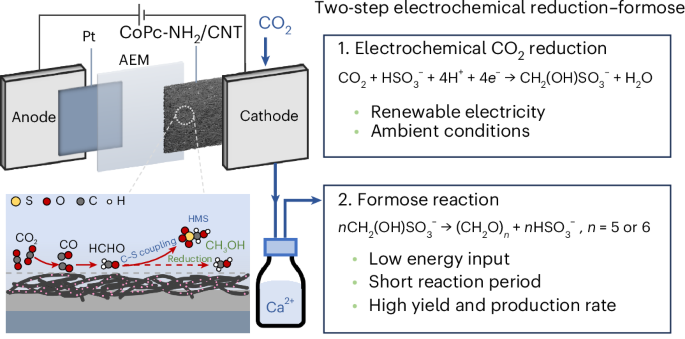
Sustainable synthesis of C5+ carbohydrates from CO2 remains challenging due to the complexity of controlled CO2 reduction and carbon–carbon coupling. Biochemical approaches can convert primary CO2 reduction products into C5+ carbohydrates, but are often constrained by lengthy reaction periods, low production rates and system complexity. Here we present a two-step electrochemical reduction–formose reaction method that uses hydroxymethanesulfonate (HMS) as a more stable surrogate for formaldehyde to facilitate the direct synthesis of C5+ carbohydrates from electrochemically fixed CO2. Using cobalt tetraaminophthalocyanine molecules supported on multiwalled carbon nanotubes as an electrocatalyst, we achieve an HMS Faradaic efficiency of ~12% at a total current density of 150 mA cm−2. Employing direct CO reduction increases the Faradaic efficiency to ~25% with over 63% carbon efficiency. The produced HMS enables an efficient formose reaction under mild conditions reaching a yield of 20.4% for C5+ carbohydrates. The CO2-derived HMS also demonstrates its versatility as a formaldehyde surrogate in other reactions for synthesizing various valuable chemical products, promising a new approach for feeding advanced chemical synthesis with electrochemically fixed CO2 via the intercepted formaldehyde intermediate.