2026-01-22 復旦大学
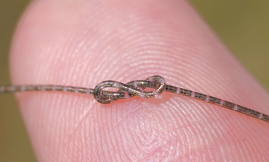
A piece of the fiber chip
<関連情報>
- https://www.fudan.edu.cn/en/2026/0122/c344a148125/page.htm
- https://www.nature.com/articles/s41586-025-09974-0
多層スパイラル構造による光ファイバー集積回路 Fibre integrated circuits by a multilayered spiral architecture
Zhen Wang,Ke Chen,Xiang Shi,Qinhao Du,Yulu Ai,Pengzhou Li,Li Yong,Xiao Sun,Ning Wang,Xuemeng Hu,Chen Lu,Chengqiang Tang,Liyuan Wang,Yuanyuan Zheng,Yichi Zhang,Hongyu Guo,Zhaofangzhou Pu,Xiaokun Wang,Yanan Zhang,Haibo Jiang,Yue Liu,Zhihang Tang,Lingsen You,Jue Deng,… Huisheng Peng
Nature Published:21 January 2026
DOI:https://doi.org/10.1038/s41586-025-09974-0
Abstract
Fibre electronic devices are transforming traditional fibres and garments into new-generation wearables that can actively interact with human bodies and the environment to shape future life1,2,3,4,5. Fibre electronic devices have achieved almost all of the desired functions, such as powering6,7, sensing8,9 and display10,11 functions. However, viable information-processing fibres, which lie at the heart of building intelligent interactive fibre systems similar to any electronic product, remain the missing piece of the puzzle12,13,14,15. Here we fill this gap by creating a fibre integrated circuit (FIC) with unprecedented microdevice density and multimodal processing capacity. The integration density reaches 100,000 transistors per centimetre, which effectively satisfies the requirements for interactive fibre systems. The FICs can not only process digital and analogue signals similar to typical commercial arithmetic chips but also achieve high-recognition-accuracy neural computing similar to that of the state-of-the-art in-memory image processors. The FICs are stable under harsh service conditions that bulky and planar counterparts have difficulty withstanding, such as repeated bending and abrasion for 10,000 cycles, stretching to 30%, twisting at an angle of 180° cm−1 and even crushing by a container truck weighing 15.6 tons. The realization of FICs enables closed-loop systems in a single fibre, without the need for any external rigid and bulky information processors. We demonstrate that this fully flexible fibre system paves the way for the interaction pattern desired in many cutting-edge applications, for example, brain–computer interfaces, smart textiles and virtual-reality wearables. This work presents new insights that can promote the development of fibre devices towards intelligent systems.