2026-01-22 国立天文台
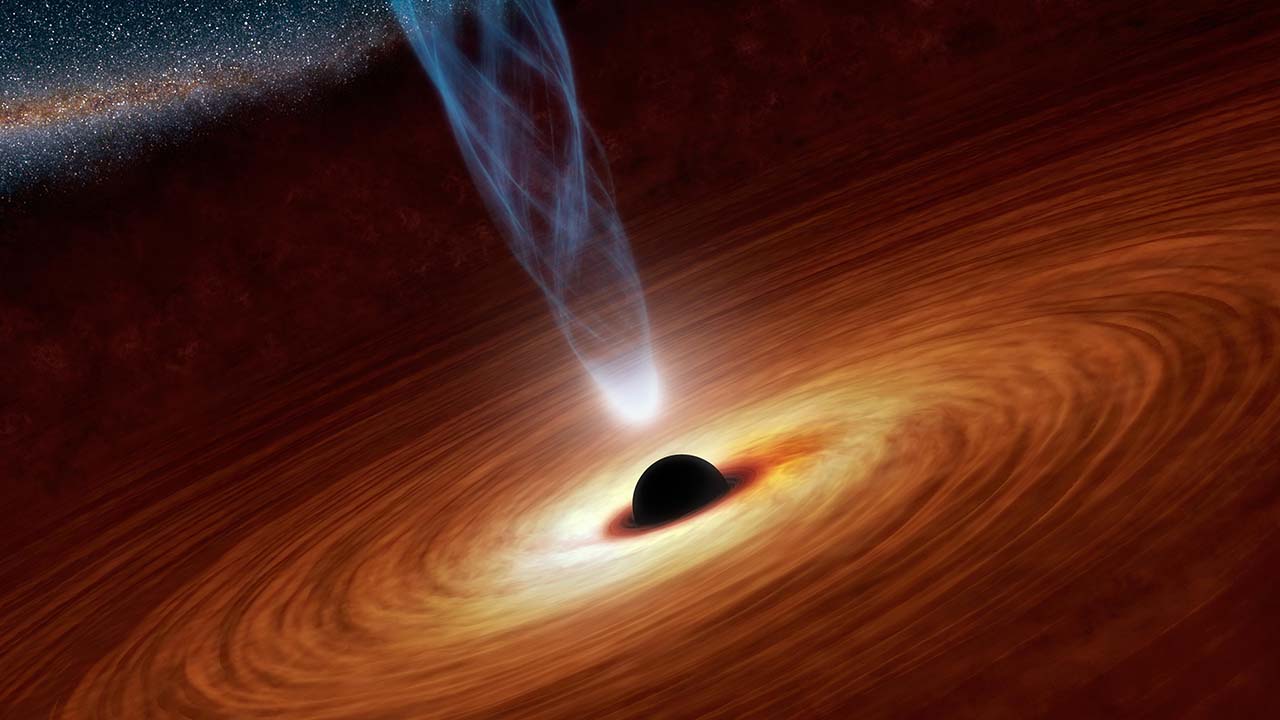
超巨大ブラックホールの想像図。中心のブラックホールにガスが降着し、降着円盤やジェットを形成している。(クレジット: NASA/JPL-Caltech)
<関連情報>
- https://www.nao.ac.jp/news/science/2026/20260122-subaru.html
- https://subarutelescope.org/jp/results/2026/01/21/3644.html
- https://iopscience.iop.org/article/10.3847/1538-4357/ae1d6d
Z = 3.4におけるX線高輝度電波クエーサーの発見:遷移的スーパーエディントン相の可能性 Discovery of an X-Ray Luminous Radio-loud Quasar at z = 3.4: A Possible Transitional Super-Eddington Phase
Sakiko Obuchi, Kohei Ichikawa, Satoshi Yamada, Nozomu Kawakatu, Teng Liu, Naoki Matsumoto, Andrea Merloni, Kosuke Takahashi, Ingyin Zaw, Xiaoyang Chen,…
The Astrophysical Journal Published: 2026 January 21
DOI:10.3847/1538-4357/ae1d6d
Abstract
We report the multiwavelength properties of eROSITA Final Equatorial Depth Survey (eFEDS) J084222.9+001000 (hereafter ID830), a quasar at z = 3.4351, identified as the most X-ray luminous radio-loud quasar in the eFEDS field. ID830 shows a rest-frame 0.5–2 keV luminosity of log(L0.5-2KeV /ergs-1)=46.20 ±0.12, with a steep X-ray photon index (Γ = 2.43 ± 0.21), and a significant radio counterpart detected with the Very Large Array FIRST 1.4 GHz and Very Large Array Sky Survey 3 GHz bands. The rest-frame UV to optical spectra from Sloan Digital Sky Survey and Subaru/MOIRCS J band show a dust-reddened quasar feature with AV = 0.39 ± 0.08 mag, and the expected bolometric active galactic nuclei luminosity from the dust-extinction-corrected UV luminosity reaches Lbol,3000Å = (7.62 ± 0.31) × 1046 erg s−1. We estimate a black hole mass of MBH = (4.40 ± 0.72) × 108 M⊙ based on the Mg IIλ2800 emission-line width, and Eddington ratios from the dust-extinction-corrected UV continuum luminosity and X-ray luminosity that reach λEdd,UV = 1.44 ± 0.24 and λEdd,X = 12.8 ± 3.9, respectively, both indicating super-Eddington accretion. ID830 shows a high ratio of UV to X-ray luminosities, αOX = −1.20 ± 0.07 (or αOX = −1.42 ± 0.07 after correcting for jet-linked X-ray excess), higher than quasars and little red dots in the super-Eddington phase with similar UV luminosities, with αOX < −1.8. Such a high αOX suggests the coexistence of a prominent radio jet and X-ray corona in this high-Eddington-accretion phase. We propose that ID830 may be in a transitional phase after an accretion burst, evolving from a super-Eddington to a sub-Eddington state, which could naturally describe the high αOX.