2026-01-22 北海道大学,モルゲンロット株式会社,大阪公立大学,中央大学,新潟大学
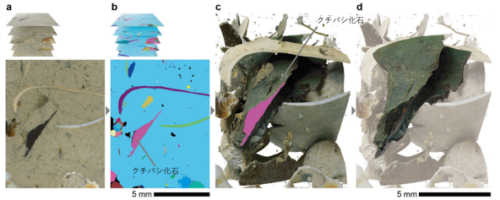
図 1.AI を搭載したデジタル化⽯マイニングの⼿順。元の連続画像データ(a)、AI で化⽯の領域を抽出したデータ(b)、抽出したすべての化⽯を、化⽯本来の⾊で 3D モデル化したもの(c)、発⾒された新種の頭⾜類のクチバシ化⽯(d)。
<関連情報>
- https://www.hokudai.ac.jp/news/2026/01/ai7000.html
- https://www.hokudai.ac.jp/news/pdf/260122_pr.pdf
- https://www.nature.com/articles/s42003-026-09519-9
ゼロショット学習AIによるデジタル化石マイニングが発見した、白亜紀の最古のセピオイド頭足類 The oldest sepioid cephalopod from the Cretaceous discovered by Digital fossil-mining with zero-shot learning AI
Kanta Sugiura,Shin Ikegami,Yusuke Takeda,Jörg Mutterlose,Mehmet Oguz Derin,Aya Kubota,Harufumi Nishida,Kazuki Tainaka,Takahiro Harada,Neil H. Landman & Yasuhiro Iba
Communications Biology Published:16 January 2026
DOI:https://doi.org/10.1038/s42003-026-09519-9
We are providing an unedited version of this manuscript to give early access to its findings. Before final publication, the manuscript will undergo further editing. Please note there may be errors present which affect the content, and all legal disclaimers apply.
Abstract
Sepioids are an evolutionarily successful group of modern ten-armed cephalopods (Decabrachia) of high biodiversity, providing a large amount of biomass in present-day oceans. They include the internally shelled order Sepiida (cuttlefish) and the soft-bodied order Sepiolida (bobtail squid). The phylogenetic position and evolutionary history of these orders are, however, so far poorly understood due to the patchy fossil record of the Decabrachia. Here we report Uluciala rotundata gen. et sp. nov. from the upper Campanian to upper Maastrichtian (~74–67 Ma, Upper Cretaceous), South Dakota, which shows an intermediate morphology between Sepiida and Sepiolida. This discovery was facilitated by a new approach in palaeontology, the Digital fossil-mining method incorporating a zero-shot learning AI model. Uluciala rotundata demonstrates a close relationship between the two sepioid orders, which has previously been interpreted controversially. Our findings indicate that sepioids experienced an early phase of radiation in the later part of the Late Cretaceous.