2026-01-13 東北大学
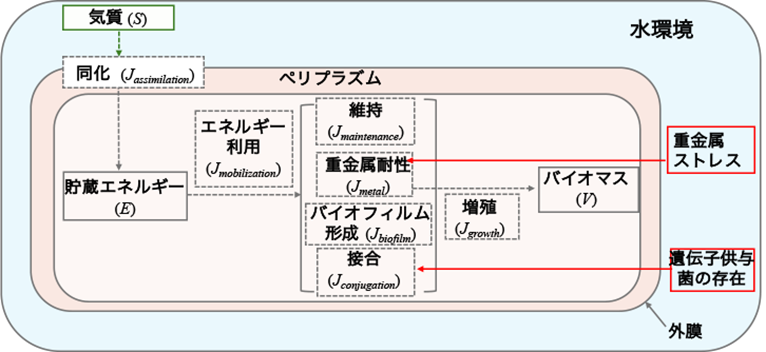
図1. 遺伝子受容菌におけるDEBに基づくエネルギー配分モデルの模式図。基質(S)は同化エネルギーフラックス(Jassimilation)によって一次エネルギー源として取り込まれ、貯蔵エネルギー(E)として蓄積される。その後、エネルギー利用フラックス(Jmobilization)を介し、維持(Jmaintenance)、増殖(Jgrowth)、重金属耐性(Jmetal)、バイオフィルム形成(Jbiofilm)、および接合(Jconjugation)に利用される。これらは金属ストレス下および遺伝子供与菌の存在という外部ストレス条件下においてバイオマス(V)の形成へとつながる。
<関連情報>
- https://www.tohoku.ac.jp/japanese/2026/01/press20260113-02-energy.html
- https://www.tohoku.ac.jp/japanese/newimg/pressimg/tohokuuniv-press20250724_01web_energy.pdf
- https://www.sciencedirect.com/science/article/pii/S0043135425021190
接合伝達、バイオフィルム形成、重金属耐性におけるエネルギー配分のトレードオフ:動的エネルギー予算理論の観点 Energy allocation trade-offs among conjugative transfer, biofilm formation, and heavy metal resistance: a dynamic energy budget theory perspective
Katayoun Dadeh Amirfard, Mohan Amarasiri , Daisuke Sano
Water Research Available online: 18 December 2025
DOI:https://doi.org/10.1016/j.watres.2025.125216
Highlights
- Energy allocation assessed using a Dynamic Energy Budget–based framework.
- Models applied include ordinary differential equations and time-point approaches.
- Zinc oxide (ZnO) reduces bacterial energy for biofilm formation and conjugation.
- Biofilm energy fell 2.3-fold at 0.1 g/L ZnO at 48 h vs the control without metal.
- ZnO prompts higher metal resistance energy allocation in the first 12 h.
Abstract
Plasmid-mediated bacterial conjugation is a significant driver of antimicrobial resistance (AMR) dissemination in the environment, particularly within surface-attached biofilms, where spatial proximity facilitates gene exchange. Environmental stressors, such as heavy metals, can influence both the structural development of biofilms and the frequency of conjugation, imposing metabolic burdens that force bacteria to reprioritize their energy use. In this study, we used a simplified Dynamic Energy Budget (DEB)-based modeling framework to evaluate energy allocation in a single-strain bacterial population exposed to varying concentrations of zinc oxide (ZnO; 0–0.1 g/L). The model incorporates substrate assimilation, reserve dynamics, and energy partitioning toward growth, maintenance, metal resistance, biofilm formation, and conjugation. Experimental data were collected every 12 h for 48 h, including total organic carbon (TOC, mg/L), biomass (CFU/mL), intracellular adenosine triphosphate (ATP, mol/mL), conjugation frequency (transconjugants/donor), and biofilm density (OD₅₅₀). Ordinary Differential Equation (ODE)–based simulations over 60 h showed that at 0.1 g/L ZnO, reserve energy and substrate declined approximately 3.1- and 1.9-fold, respectively (vs around 5- and 2.9-fold in control), indicating reduced depletion. Discrete-time-point flux models revealed conjugation demanded 17% of total energy at 36 h under 0.01 g/L ZnO, and 10% under 0.1 g/L at 60 h, while energy allocated to biofilm formation remained ≤ 3% under the highest ZnO concentration. Overall, the model reveals key trade-offs in bacterial energy allocation and provides mechanistic insight into how metal stress may shape biofilm formation and conjugation dynamics. Its modular and data-driven structure offers a basis for understanding microbial adaptation and AMR propagation in metal-contaminated environments.