2025-10-24 アメリカ合衆国・オハイオ州立大学 (OSU)
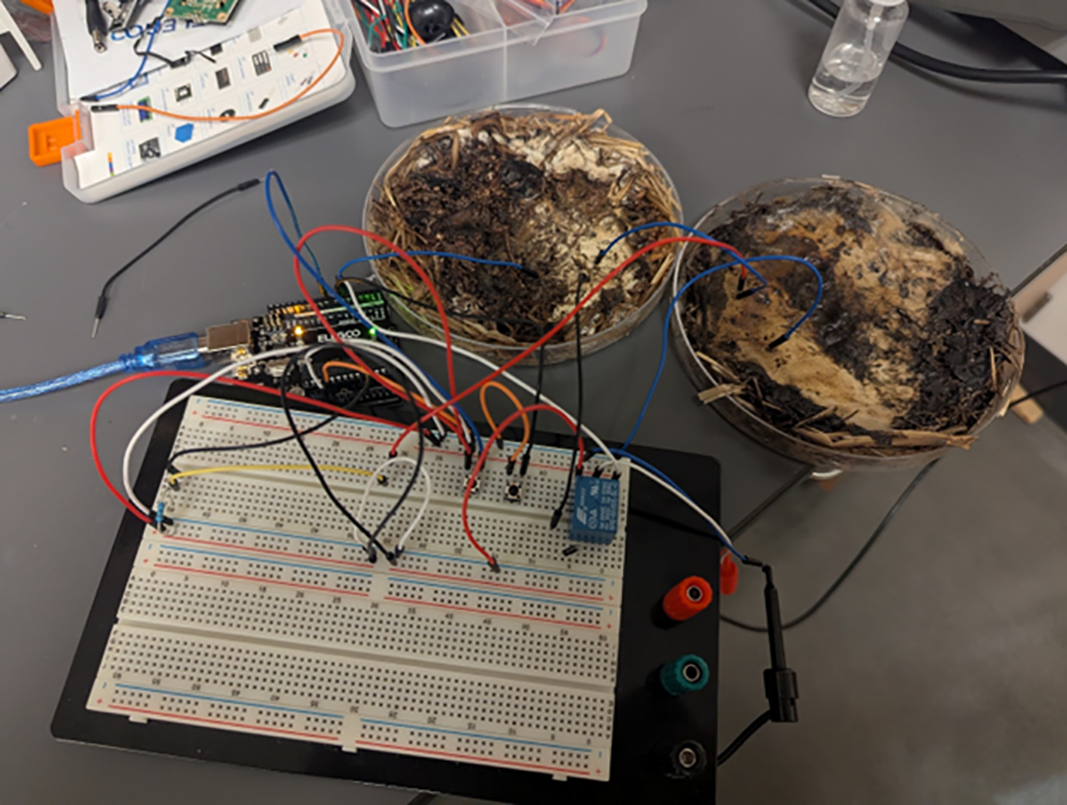
Fungal memristors could be ideal interfaces for high-frequency bioelectronics, researchers say.Photo provided by John LaRocco.
<関連情報>
- https://news.osu.edu/powered-by-mushrooms-living-computers-are-on-the-rise/
- https://journals.plos.org/plosone/article?id=10.1371/journal.pone.0328965
高周波バイオエレクトロニクスのためのシイタケ菌糸体由来の持続可能なメモリスタ Sustainable memristors from shiitake mycelium for high-frequency bioelectronics
John LaRocco ,Qudsia Tahmina,Ruben Petreaca,John Simonis,Justin Hill
PLOS One Published: October 10, 2025
DOI:https://doi.org/10.1371/journal.pone.0328965
Abstract
Neuromorphic computing, inspired by the structure of the brain, offers advantages in parallel processing, memory storage, and energy efficiency. However, current semiconductor-based neuromorphic chips require rare-earth materials and costly fabrication processes, whereas neural organoids need complex bioreactor maintenance. In this study, we explored shiitake (Lentinula edodes) fungi as a robust, sustainable alternative, exploiting its adaptive electrical signaling, which is akin to neuronal spiking. We demonstrate fungal computing via mycelial networks interfaced with electrodes, showing that fungal memristors can be grown, trained, and preserved through dehydration, retaining functionality at frequencies up to 5.85 kHz, with an accuracy of 90 ± 1%. Notably, shiitake has exhibited radiation resistance, suggesting its viability for aerospace applications. Our findings show that fungal computers can provide scalable, eco-friendly platforms for neuromorphic tasks, bridging bioelectronics and unconventional computing.