2026-01-05 東京農工大学
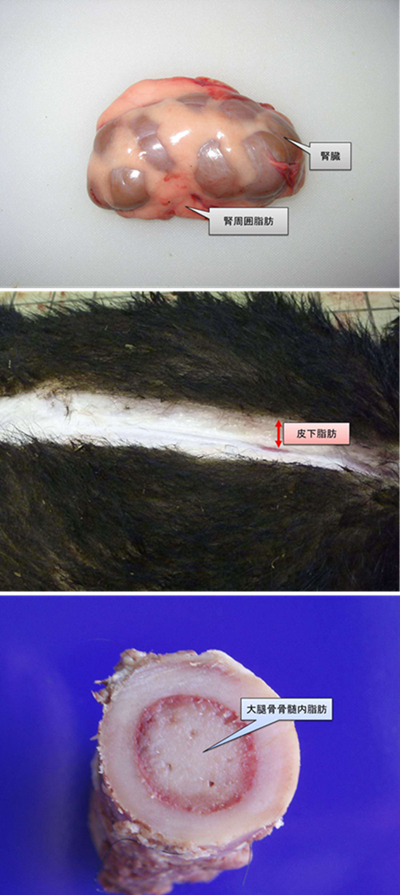
図1:上から測定に用いたツキノワグマの内臓脂肪(修正腎周囲脂肪指数)、皮下脂肪、骨髄脂肪(大腿骨骨髄内脂肪)の一例。
<関連情報>
- https://www.tuat.ac.jp/outline/disclosure/pressrelease/2025/20260105_01.html
- https://www.tuat.ac.jp/documents/tuat/outline/disclosure/pressrelease/2025/20260105_01.pdf
- https://bioone.org/journals/mammal-study/volume-51/issue-1/ms2025-0018/Variation-in-Fat-Accumulation-is-Associated-with-Food-Availability-in/10.3106/ms2025-0018.short
アジアツキノワグマの脂肪蓄積の変化は食物の入手可能性と関連している Variation in Fat Accumulation is Associated with Food Availability in Asian Black Bears
Seigo Sawada, Kahoko Tochigi, Hiroki Kanamori, Sam M. J. G. Steyaert, Shinsuke Koike
Mammal Study Published:20 December 2025
DOI:https://doi.org/10.3106/ms2025-0018
Abstract
This study aimed to clarify annual and seasonal variation in fat accumulation in Asian black bears (Ursus thibetanus) in western Japan and to understand the importance of the carryover pattern (i.e., fat dynamics) of energy stores in bears. Body fat accumulation in bears (aged 2–25 years) was measured using three fat indices (modified kidney fat index [mKFI], subcutaneous fat [SF], and femoral marrow fat [FMF]) from 2003 to 2018. The results showed that fat accumulation varied seasonally, with SF and mKFI peaking in autumn. Fat stores appeared to be consumed during hibernation and continued to decrease into summer. Similarly, FMF decreased during summer. Our data suggest that SF is the first fat reserve utilized by bears, followed by mKFI and FMF. Additionally, fat accumulation differed between sexes, with females showing higher SF and mKFI levels than males. The amount of fat accumulated in autumn appeared to decline in years with poor hard mast production, and this effect extended into the following year. This carryover effect was evident in mKFI and FMF, which are utilized later than SF.