2026-01-13 中国科学院(CAS)
<関連情報>
- https://english.cas.cn/newsroom/research-news/202602/t20260210_1150329.shtml
- https://iopscience.iop.org/article/10.3847/1538-4357/ae1ba0
SN 2024gy: Ia型超新星の遅延爆発を示唆する多段階スペクトル特徴 SN 2024gy: Multiepoch Spectroscopic Features Suggestive of Delayed Detonation in a Type Ia Supernova
Liping Li, Zhenyu Wang, Jialian Liu, Yu Pan, Alexei V. Filippenko, Jujia Zhang, Xiaofeng Wang, Brajesh Kumar, Yi Yang, Thomas G. Brink,…
The Astrophysical Journal Published: 2025 December 22
DOI:10.3847/1538-4357/ae1ba0
Abstract
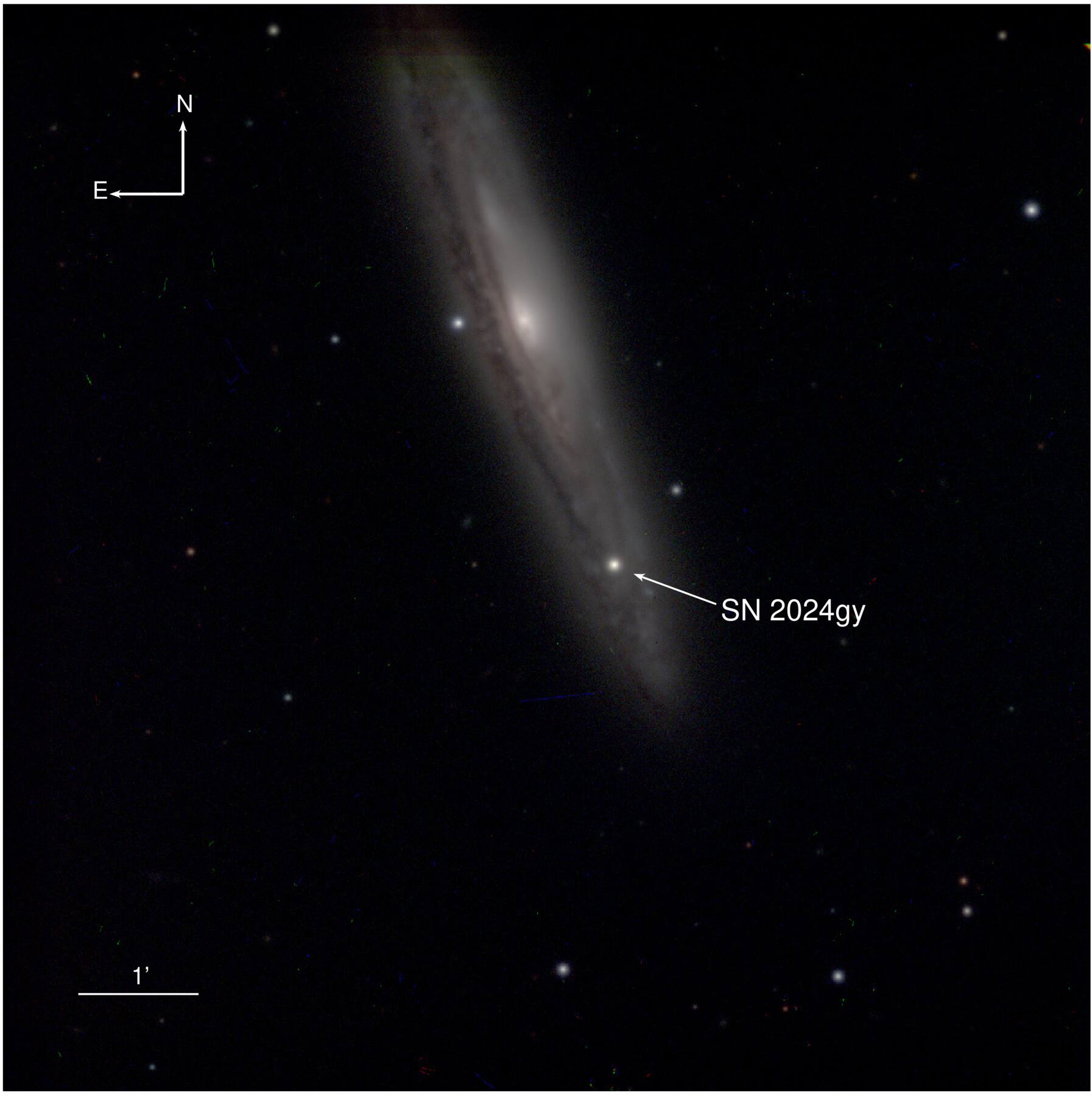
We present photometric and spectroscopic observations of SN 2024gy, a Type Ia supernova (SN Ia) exhibiting high-velocity features (HVFs) in its early-time spectra. This SN reaches a peak B-band magnitude of −19.25 ± 0.29 mag and subsequently declines by Δm15(B) ≈ 1.12 mag, consistent with the luminosity–width relation characteristic of normal SNe Ia. Based on the peak thermal luminosity of (1.2 ± 0.3) × 1043 erg s−1, we estimate that 0.57 ± 0.14 M⊙ of 56Ni was synthesized during the explosion. Our dense early spectral monitoring revealed significant velocity disparities within the ejecta. Notably, absorption features from the Ca ii near-infrared triplet were observed at velocities exceeding 25,000 km s−1, while the Si ii λ6355 line velocity at the same epoch was significantly lower at ∼16,000 km s−1. This velocity disparity likely reflects distinct ionization states of intermediate-mass elements in the outermost layers. The prominent Ca ii HVFs may originate from ionization suppression within the highest-velocity ejecta, potentially indicative of minimal hydrogen mixing in a delayed-detonation explosion scenario. Additionally, the Ni/Fe ratio derived from the nebular spectrum of SN 2024gy provides further support for this model.