2026-01-08 ハーバード大学
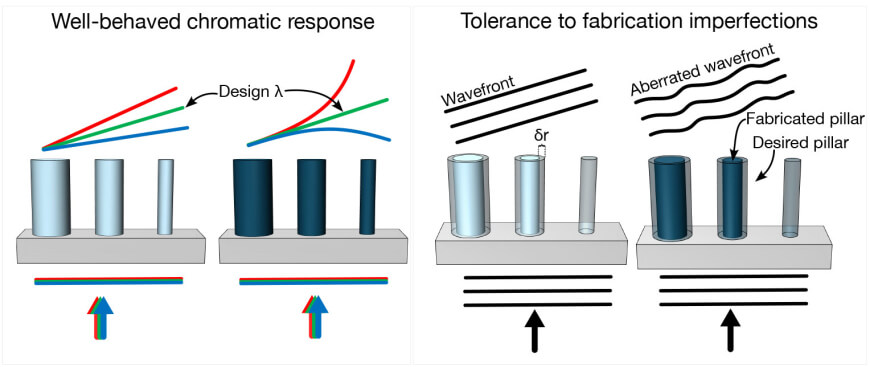
A figure that outlines the advantages of low refractive index metasurfaces.
<関連情報>
- https://seas.harvard.edu/news/2026/01/unexpected-breakthrough-flat-optics
- https://pubs.acs.org/doi/10.1021/acs.nanolett.5c04960
シリカメタオプティクス:高性能なのに高屈折率は必要ない Silica Meta-Optics: When High Performance Does Not Need a High Index
Luca Sacchi,Alfonso Palmieri,Vitthal Mishra,Joon-Suh Park,Marco Piccardo,and Federico Capasso
Nano Letters Published: December 8, 2025
DOI:https://doi.org/10.1021/acs.nanolett.5c04960
Abstract
Metasurfaces, planar arrays of subwavelength nanostructures, are typically realized with high-index dielectrics, while low-index platforms are often dismissed due to weaker index contrast. We identify and experimentally verify regimes where a low-index platform (SiO2) surpasses its high-index counterpart (TiO2). A low index suppresses higher-order Bloch modes, enabling the design of efficient devices with relaxed feature sizes. Low-index metasurfaces also offer two intrinsic advantages: a broad, well-behaved chromatic response without explicit dispersion engineering and a strong tolerance to fabrication errors. We validate these features experimentally with silica metagratings, metalenses, and structured-light phase plates at λ = 632 nm. The metagratings reach ≥50% absolute diffraction efficiency over a 200 nm bandwidth, the metalenses deliver 75% absolute diffraction efficiency with diffraction-limited performance, and the vortex phase plates achieve 80% conversion efficiency at the design wavelength and 60% with 100 nm wavelength detuning. These results delineate when low-index metasurfaces outperform high-index designs, suggesting a route to scalable and broadband fabrication of error-resilient flat optics.