2026-01-08 チャルマース工科大学
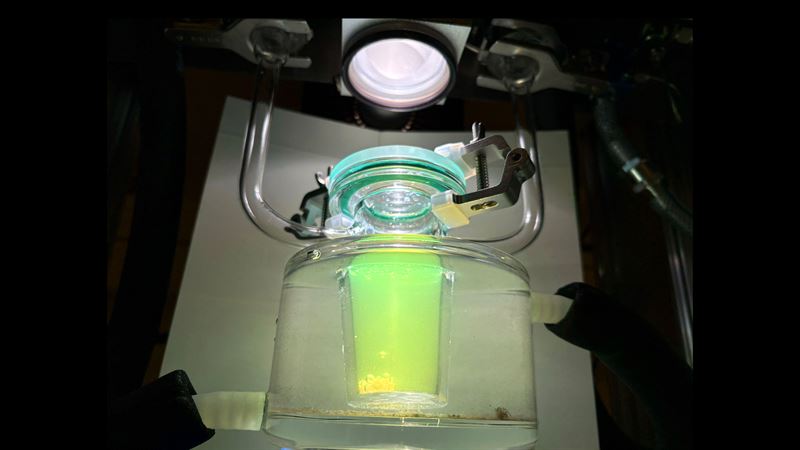
A green advance | A research breakthrough opens up for efficient hydrogen production from solar energy – without using the scarce metal platinum. In a reactor at a chemistry laboratory at Chalmers University of Technology, Sweden, bubbles of hydrogen gas can be easily seen with the naked eye as they form – showing that photocatalysis is happening efficiently. Image: Chalmers University of Technology | Mia Halleröd Palmgren
<関連情報>
- https://news.cision.com/chalmers/r/solar-hydrogen-can-now-be-produced-efficiently-without-the-scarce-metal-platinum,c4287449
- https://advanced.onlinelibrary.wiley.com/doi/10.1002/adma.202507702
低コスト共役ポリマーナノ粒子からの高効率な白金フリー光触媒水素発生 Highly Efficient Platinum-Free Photocatalytic Hydrogen Evolution From Low-cost Conjugated Polymer Nanoparticles
Alexandre Holmes, Jingwen Pan, Li Wang, Leandro Franco, Rafael R. Bicudo, Bo Albinsson, C. Moyses Araujo, Weiguo Zhu, Dongbo Wang, Thuc-Quyen Nguyen, Jiefang Zhu, Ergang Wang
Advanced Materials Published: 22 July 2025
DOI:https://doi.org/10.1002/adma.202507702
Abstract
While the interest in hydrogen photocatalysis from organic semiconductors is rapidly growing, there is a necessity to achieve hydrogen production without platinum (Pt), considering its price, availability and toxicity. In this work, this is demonstrated that high hydrogen evolution reaction (HER) efficiencies can be achieved without the use of Pt. A series of low-cost conjugated polymers are designed around the dibenzothiophene-S,S-sulfoxide (BTSO) unit, and self-assembled as nanoparticles in water via the nanoprecipitation technique. This is highlighted that how side chain engineering, nanoparticle morphology and pH influence the hydrogen evolution rate. Optoelectronic properties are improved through a Donor-Acceptor structure, resulting in an unprecedented hydrogen evolution reaction rate of 209 mmol g−1 h−1 in the absence of Pt. A clear correlation between high efficiencies and number of BTSO units within the polymer backbone can be established. The design rules pioneer the design of future organic materials is presented for a cost-efficient and sustainable hydrogen photocatalysis.