2025-12-16 中国科学院(CAS)
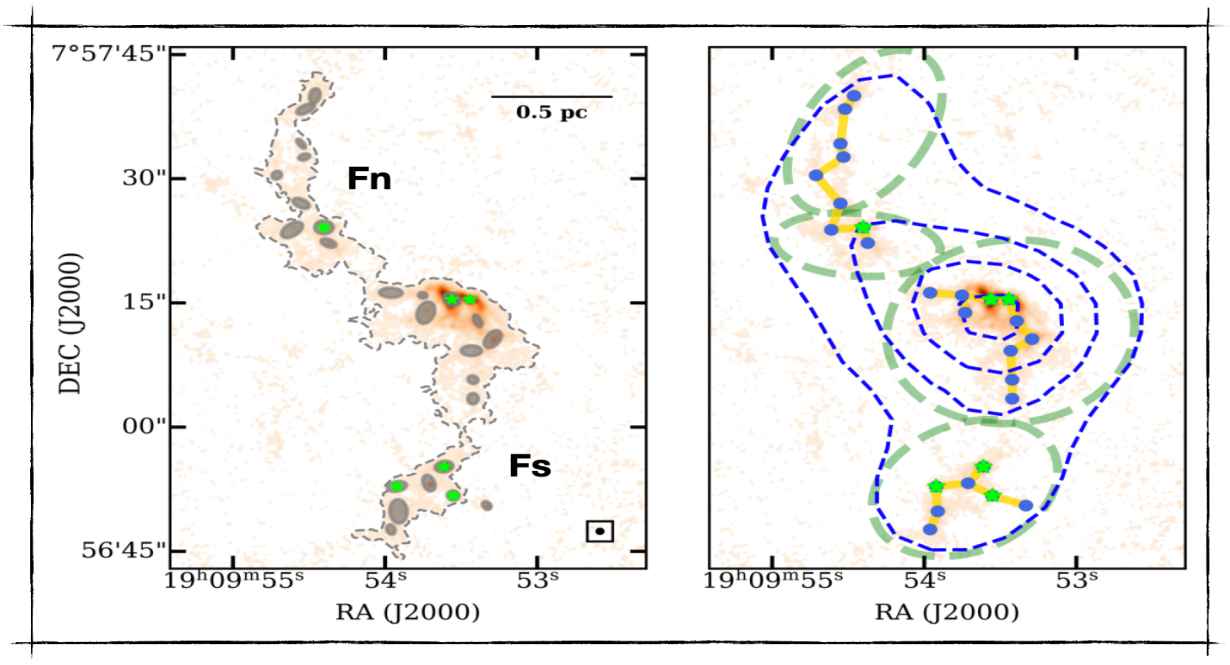
Left: The S-shaped structure in the target region I19074, with gray ellipses marking dense cores and green symbols indicating protostars. Scale bars and resolution indicators are shown in the upper-right and lower-right corners. Right: Distribution of core spacings within the S-shaped structure, where green ellipses represent clumps and blue dots denote cores. (Image by SHAO)
<関連情報>
- https://english.cas.cn/newsroom/research_news/phys/202512/t20251217_1137299.shtml
- https://www.aanda.org/articles/aa/full_html/2025/12/aa56572-25/aa56572-25.html
INFANTサーベイの一環として観測されたS字型高質量星形成フィラメントIRAS 19074+0752のマルチスケール画像 Multi-scale view of the S-shaped high-mass star-forming filament IRAS 19074+0752 observed as part of the INFANT survey
Y. Q. Guo, H.-L. Liu, X. Lu,, Y. Cheng, H. B. Liu, L. M. Zhen, Q. Zhang, S. H. Jiao,, X. C. Liu, T. Liu, R. Galván-Madrid, P. Sanhueza, D. T. Yang, F. Nakamura,, L. Chen, S. Y. Feng, K. Wang, Q. L. Gu, Q. Y. Luo, Y. Lin, P. S. Li, S. H. Li,, K. Tanaka and A.E. Guzmán
Astronomy & Astrophysics Published:15 December 2025
DOI:https://doi.org/10.1051/0004-6361/202556572
Abstract
Context. It is generally accepted that high-mass stars form through a hierarchical, multi-scale fragmentation process that range from molecular clouds down to individual protostars, involving intermediate scales such as filaments. However, a comprehensive understanding of this process remains limited due to the lack of high-resolution, multi-scale observational studies that would simultaneously probe the physical conditions across the full hierarchy of star-forming structures.
Aims. We aim to understand a coherent picture of the physical processes connecting filament formation, fragmentation, and dynamical scenario of high-mass star formation in the IRAS 19074+0752 (hereafter I19074) region.
Methods. Primarily using new 1.3 mm continuum mosaicked observations, as part of the ALMA-INFANT survey, we analyzed the S-shaped filamentary cloud I19074 at a ∼6000 AU resolution. Leveraging the multi-scale information, we investigated the filament and clump fragmentation properties, such as core separations and masses.
Results. ALMA 1.3 mm dust continuum emission reveals that the S-shaped filament consists of two physically connected components: a southern (Fs) and a northern (Fn) segment. Fn is associated with an infrared (IR)-bright HII region, while Fs appears IR-dark. The total filament length is ∼2.8 pc, with Fn and Fs spanning ∼1.0 pc and ∼1.8 pc, respectively. Their masses are ∼250−910 M⊙, while their line masses (∼250−360 M⊙ pc−1) exceed the critical value for turbulence support, indicating they are gravitationally bound. The S-shaped morphology likely results from the expansion of the HII region, which swept up and compressed the northern part of the pre-existing filament into an arc-like structure in Fn; meanwhile, Fs retained a more linear form due to its greater distance from the ionized gas. Accordingly, a hybrid scenario could be responsible for Fn formation, which would combine the compression of a preexisting filament by the HII region with fresh gas accumulation into the shocked-compression layer. We extracted 26 dense cores from 1.3 mm emission with masses between 1.0 and 22.9 M⊙, with most (92%) being gravitationally bound (αvir ≤ 2). The core separations lack periodicity; instead, four core groups define four clumps (clumps 1-4) with masses of 110−620 M⊙. In the Fs segment, clump 1 at its southern end could be a product of edge fragmentation, while Fn exhibits hierarchical fragmentation modes: the filamentary mode responsible for clump formation within Fn and the spherical Jeans-like mode for core formation within clumps. Hierarchical fragmentation mechanisms are identified as shocked turbulence-driven within Fn and gravity-driven inside the clumps. Most cores have high mass surface densities of Σcore ≥ 1 g cm−2, but with no robust identification of high-mass prestellar candidates. This favors dynamical clump-fed accretion-type over core-fed accretion-type models for high-mass star formation in I19074.
Conclusions. The S-shaped filament in the I19074 region likely formed through the interaction with an expanding H II region, with the shocked-shell fragmentation mechanism in Fn and edge fragmentation in Fs serving as pathways for producing massive, star-forming clumps. Both mechanisms contribute to high-mass star formation via a dynamical clump-fed accretion process within their respective filamentary segments.