2025-12-19 物質・材料研究機構,京都工芸繊維大学,高輝度光科学研究センター,兵庫県立大学,ダルムシュタット工科大学,科学技術振興機構
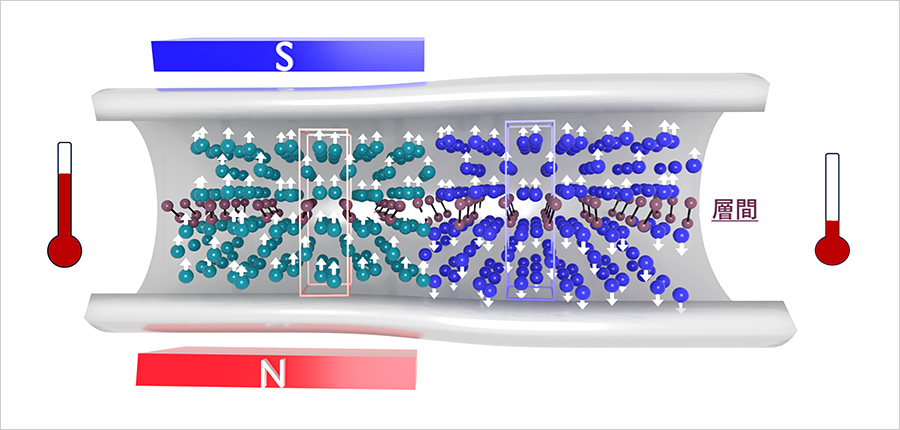
図: 今回開発した材料の模式図。磁場を印加していない状態(右側)では、上側のスラブ(以下、層と標記)と下層に含まれるGdのスピンの向き(白矢印)は揃っていないが、磁場を印加すると(左側)揃い、温度が上昇する。
<関連情報>
- https://www.nims.go.jp/press/2025/12/202512190.html
- https://www.nims.go.jp/press/2025/12/ui667t0000008xdp-att/202512190.pdf
- https://advanced.onlinelibrary.wiley.com/doi/10.1002/adma.202514295
共有結合の制御により効率的な磁気冷却が可能に Control of Covalent Bond Enables Efficient Magnetic Cooling
Xin Tang, Yoshio Miura, Noriki Terada, Enda Xiao, Shintaro Kobayashi, Allan Döring, Terumasa Tadano, Andres Martin-Cid, Takuo Ohkochi, Shogo Kawaguchi, Yoshitaka Matsushita …
Advanced Materials Published: 17 December 2025
DOI:https://doi.org/10.1002/adma.202514295
Abstract
Magnetic cooling, harnessing the temperature change in matter when exposed to a magnetic field, presents an energy-efficient and climate-friendly alternative to traditional vapor-compression refrigeration systems, with a significantly lower global warming potential. The advancement of this technology would be accelerated if irreversible losses arising from hysteresis in magnetocaloric materials are minimized. Despite extensive efforts to manipulate crystal lattice constants at the unit-cell level, mitigating hysteresis often compromises cooling performance. Herein, we address this persistent challenge by forming Sn(Ge)3−Sn(Ge)3 bonds within the unit cell of the Gd5Ge4 compound. This approach enables an energetically favorable phase transition, leading to the elimination of thermal hysteresis. Consequently, we achieve a synergistic improvement of two key magnetocaloric figures of merit: a larger magnetic entropy change and a twofold increase in the reversible adiabatic temperature change (from 3.8 to 8 K) in the Gd5Sn2Ge2 compound. Such synergies can be extended over a wide temperature range of 40–160 K. This study demonstrates a paradigm shift in mastering hysteresis toward simultaneously achieving exceptional magnetocaloric metrics and opens up promising avenues for gas liquefaction applications in the longstanding pursuit of sustainable energy solutions.