2025-12-04 中国科学院(CAS)
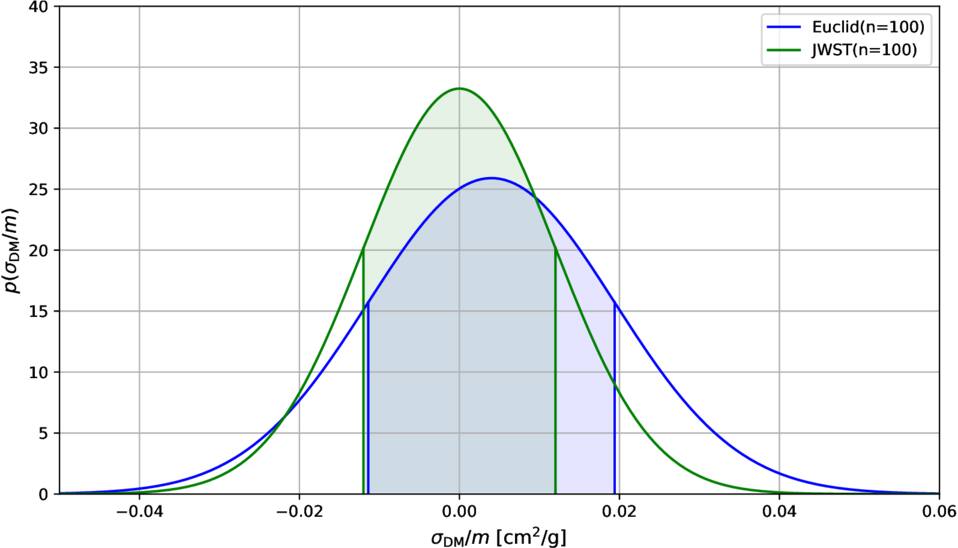
Robustness test of the CKAN under simulated observational noise. The green and blue curves represent noise levels corresponding to JWST and Euclid specifications, respectively, where n denotes the sample size. The plot displays the trained CKAN’s predictions on an unseen test set of CDM-hi AGN samples (with a ground-truth cross-section of zero). (Image by XAO)
<関連情報>
- https://english.cas.cn/newsroom/research_news/phys/202512/t20251217_1137294.shtml
- https://iopscience.iop.org/article/10.3847/1538-3881/ae0476
銀河団における自己相互作用と冷たい暗黒物質を解き明かす解釈可能なAIフレームワーク:CKANアプローチ An Interpretable AI Framework to Disentangle Self-interacting and Cold Dark Matter in Galaxy Clusters: The CKAN Approach
Zhenyang Huang, Haihao Shi, Zhiyong Liu, and Na Wang
The Astronomical Journal Published: 2025 October 10
DOI:10.3847/1538-3881/ae0476
Abstract
Convolutional neural networks have shown their ability to differentiate between self-interacting dark matter (SIDM) and cold dark matter on galaxy cluster scales. However, their large parameter counts and “black-box” nature make it difficult to assess whether their decisions adhere to physical principles. To address this issue, we have built a convolutional Kolmogorov–Arnold network (CKAN) that reduces parameter count and enhances interpretability, and propose a novel analytical framework to understand the network’s decision-making process. With this framework, we leverage our network to qualitatively assess the offset between the dark matter distribution center and the galaxy cluster center, as well as the size of heating regions in different models. These findings are consistent with current theoretical predictions and show the reliability and interpretability of our network. By combining network interpretability with unseen test results, we also estimate that for SIDM in galaxy clusters, the minimum cross section (σ/m)th required to reliably identify its collisional nature falls between 0.1 and 0.3 cm2 g−1. Moreover, CKAN maintains robust performance under simulated JWST and Euclid noise, highlighting its promise for application to forthcoming observational surveys.