2025-12-03 マサチューセッツ工科大学(MIT)
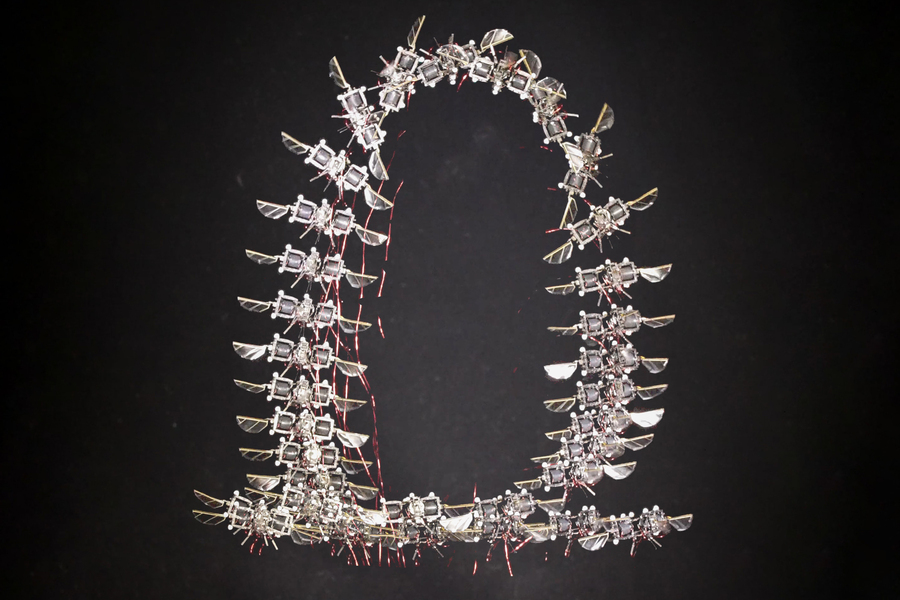
A time-lapse photo shows a flying microrobot performing a flip.Credit: Courtesy of the Soft and Micro Robotics Laboratory
<関連情報>
- https://news.mit.edu/2025/mit-engineers-design-aerial-microrobot-fly-like-bumblebee-1203
- https://www.science.org/doi/10.1126/sciadv.aea8716
- https://www.science.org/doi/10.1126/scirobotics.adp4256
- https://tiisys.com/blog/2021/04/19/post-86152/
深層学習によるロバストチューブモデル予測制御による昆虫サイズの羽ばたき飛行ロボットの曲技飛行 Aerobatic maneuvers in insect-scale flapping-wing aerial robots via deep-learned robust tube model predictive control
Yi-Hsuan Hsiao, Andrea Tagliabue, Owen Matteson, Suhan Kim, […] , and YuFeng Chen
Science Advances Published:3 Dec 2025
DOI:https://doi.org/10.1126/sciadv.aea8716
Abstract
Aerial insects exhibit agile maneuvers such as sharp braking, saccades, and body flips under disturbances; in contrast, insect-scale aerial robots are limited to tracking smooth trajectories with small acceleration. To achieve similar flight capabilities, insect-scale robots require a robust and computationally efficient controller. Here, through designing a deep-learned robust tube model predictive controller, we showcase exceptional flight agility in a 750-milligram flapping-wing robot. Our neural network controller can track aggressive trajectories and run at a high rate on a compute-constrained system. The robot demonstrates saccades with a lateral speed and acceleration of 197 centimeters per second and 11.7 meters per square second, respectively, representing improvements of 447 and 255% over prior results. The robot also performs saccades under 160–centimeters per second wind disturbance and completes 10 consecutive somersaults in 11 seconds. These results represent a milestone in achieving insect-scale flight agility and inspire future investigations on sensory and compute autonomy.
昆虫スケールのアクロバット:耐久性、精度、機敏性に優れたマイクロ航空ロボット Acrobatics at the insect scale: A durable, precise, and agile micro–aerial robot
Suhan Kim, Yi-Hsuan Hsiao, Zhijian Ren, Jiashu Huang, and Yufeng Chen
Science Robotics Published:15 Jan 2025
DOI:https://doi.org/10.1126/scirobotics.adp4256
Abstract
Aerial insects are exceptionally agile and precise owing to their small size and fast neuromotor control. They perform impressive acrobatic maneuvers when evading predators, recovering from wind gust, or landing on moving objects. Flapping-wing propulsion is advantageous for flight agility because it can generate large changes in instantaneous forces and torques. During flapping-wing flight, wings, hinges, and tendons of pterygote insects endure large deformation and high stress hundreds of times each second, highlighting the outstanding flexibility and fatigue resistance of biological structures and materials. In comparison, engineered materials and microscale structures in subgram micro–aerial vehicles (MAVs) exhibit substantially shorter lifespans. Consequently, most subgram MAVs are limited to hovering for less than 10 seconds or following simple trajectories at slow speeds. Here, we developed a 750-milligram flapping-wing MAV that demonstrated substantially improved lifespan, speed, accuracy, and agility. With transmission and hinge designs that reduced off-axis torsional stress and deformation, the robot achieved a 1000-second hovering flight, two orders of magnitude longer than existing subgram MAVs. This robot also performed complex flight trajectories with under 1-centimeter root mean square error and more than 30 centimeters per second average speed. With a lift-to-weight ratio of 2.2 and a maximum ascending speed of 100 centimeters per second, this robot demonstrated double body flips at a rotational rate exceeding that of the fastest aerial insects and larger MAVs. These results highlight insect-like flight endurance, precision, and agility in an at-scale MAV, opening opportunities for future research on sensing and power autonomy.