2025-12-06 国立環境研究所
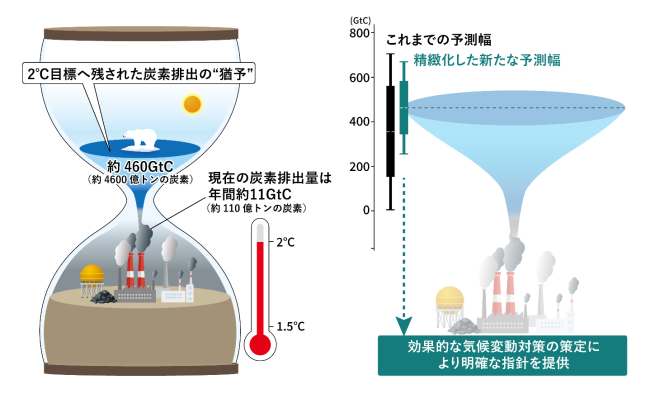
図1:産業革命前からの気温上昇を2℃に抑えるために残された排出量
<関連情報>
- https://www.nies.go.jp/whatsnew/2025/20251206/20251206.html
- https://www.cell.com/one-earth/fulltext/S2590-3322(25)00352-5
将来の地球気温と残りの炭素予算に関する不確実性が縮小 Narrowed uncertainty in future global temperature and remaining carbon budget
Irina Melnikova ∙ Tokuta Yokohata ∙ Hideo Shiogama
One Earth Published:December 5, 2025
DOI:https://doi.org/10.1016/j.oneear.2025.101526
Science for society
Understanding and reducing uncertainties in future global warming is essential for protecting societies and ecosystems. Human-driven CO2 emissions are the main cause of climate change, but the Earth-system response—how much additional warming results from each ton of emissions—remains uncertain. This study develops a new approach to narrow those uncertainties by accounting for feedbacks between the land, oceans, and atmosphere, especially under high-emission future scenarios. By improving the precision of global temperature projections, this work provides more reliable estimates of the “remaining carbon budget,” the total amount of CO2 that can still be emitted before crossing critical warming thresholds of 2°C and 3°C above preindustrial levels. These refined estimates help governments, businesses, and communities make better decisions when setting emission-reduction targets and preparing adaptation strategies. Our results highlight both opportunity and urgency. Even under the more optimistic constrained projections, global warming of 2°C could be reached within the next few decades. By reducing scientific uncertainty, our study empowers society to act with greater confidence. A clearer understanding of the risks and time frames ahead helps decision-makers avoid the dangers of delay and work toward a safer, more sustainable future for people and the planet.
Highlights
- We present an emergent constraint on future warming in response to carbon emissions
- The emergent constraint incorporates both climate and carbon-cycle feedbacks
- We reduce uncertainty in future warming and remaining carbon budgets for 2°C and 3°C
- Refined projections support effective climate mitigation and adaptation strategies
Summary
Reducing uncertainty in future temperature projections is crucial for understanding climate impacts of anthropogenic CO2 emissions and for guiding effective climate policy. This remains a complex challenge, as uncertainty in temperature projections arises from both climate and carbon-cycle feedbacks. Here, we introduce an observational constraint that integrates these feedbacks into emissions-driven simulations, reducing uncertainties in projected global temperature and effective transient climate response to cumulative CO2 emissions (eTCRE). Our approach lowers the projected mid-21st century eTCRE from 2.2°C (1.3°C–3.1°C) to 1.9°C (1.3°C–2.5°C) per 1,000 GtC. It also reduces projected end-of-century global temperature from 4.6°C (2.8–6.4°C) to 4.2°C (2.9°C–5.4°C) and refines estimates of the remaining carbon budget since 2020 for limiting warming to 2°C from 352.2 (2.1–702.3) to 458.9 (251.4–666.3) GtC under high-emission representative concentration pathway (RCP)8.5/shared socioeconomic pathway (SSP)5–8.5 scenarios. These refined projections provide critical insights for policymakers, enabling more effective mitigation strategies.