2025-12-12 中国科学院(CAS)
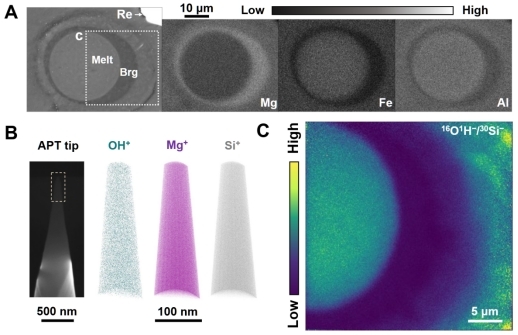
Probing water in a tiny experiment sample. (Image by Prof. DU Zhixue’s team)
<関連情報>
- https://english.cas.cn/newsroom/research_news/earth/202512/t20251212_1136055.shtml
- https://www.science.org/doi/10.1126/science.adx5883
地球の深部マントルに初期から保持されていた大量の水 Substantial water retained early in Earth’s deep mantle
Wenhua Lu, Ya-Nan Yang, Tao Long, Haiyang Xian, […] , and Zhixue Du
Science Published:11 Dec 2025
DOI:https://doi.org/10.1126/science.adx5883
Editor’s summary
Where did all the water go when Earth’s early magma oceans crystallized? For the deepest mantle, the answer has been elusive. To recreate lower-mantle temperature and pressure, Lu et al. applied laser heating to silicate glass in a diamond anvil cell (see the Perspective by Walter). Bridgmanite, the lower mantle’s most common mineral, formed in equilibrium with silicate melt and strongly partitioned water as the temperature increased. These experiments indicate that after magma ocean crystallization, bridgmanite may have stored an ocean’s worth of water in the lower mantle. This deep reservoir would have affected the planet’s water budget during subsequent mantle cooling and convection. —Angela Hessler
Abstract
Earth’s water was likely acquired early, when our planet was extensively molten because of large to giant impacts. How such early water was retained and distributed within a crystallizing mantle remains unclear. In this study, we investigated partitioning of water between bridgmanite, the first and primary mantle mineral to crystallize, and coexisting melt through systematic high-pressure experiments. Our results demonstrate that partitioning of water into bridgmanite is strongly enhanced by increasing temperature. Thus, appreciable amounts of water may have been retained in the lower mantle after its crystallization. Circulation of such early stored water in Earth’s interior could have modulated mantle dynamics and influenced the transition of early Earth to a habitable planet.