2025-11-04 国立環境研究所
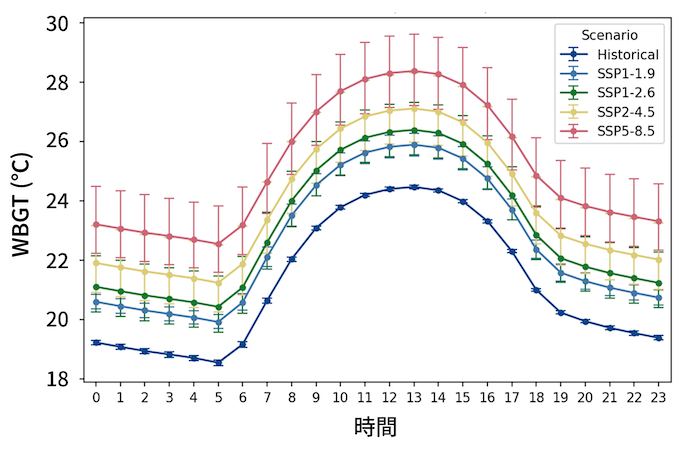
図1 2060~2080年代の8月における全国平均の時間別WBGT
(4つの排出シナリオ(SSP1-1.9/SSP1-2.6/SSP2-4.5/SSP5-8.5)に基づく予測値と、過去(1980-2014年平均)の値を示す。点は5つの気候モデルの平均値、エラーバーは5つの気候モデルによる予測の幅を表す。)
<関連情報>
- https://www.nies.go.jp/whatsnew/2025/20251104/20251104.html
- https://www.sciencedirect.com/science/article/pii/S0013935125022017?via%3Dihub
気候変動と人口動態の変化下における日本全国における高齢者の暑熱リスク予測と介入費用分析 Nationwide high-resolution heat risk projections and intervention cost analysis for the elderly in Japan under climate and demographic changes
Takahiro Oyama, Jun’ya Takakura, Noriko N. Ishizaki, Kazutaka Oka, Yasushi Honda, Yoshifumi Masago, Yasuaki Hijioka
Environmental Research Available online: 5 October 2025
DOI:https://doi.org/10.1016/j.envres.2025.122949
Highlights
- Heat-related health risk may affect 32 million elderly in the 2060–2080s.
- Over 40 % of elderly will be at risk in most Japanese municipalities.
- Risky heat exposure may double under the highest emission scenario vs. the lowest.
- Annual intervention costs of 164–177 million USD are projected.
- Cost-effectiveness varies by discount rate for future health impacts.
Abstract
Global warming and population aging are amplifying heat-related health risks in Japan. The country records approximately 1000 heatstroke deaths annually, over 80 % of which involve elderly people. This study aimed to project future elderly populations at risk of heat exposure and to evaluate the costs of potential interventions under climate and demographic changes. Using high-resolution (1 km) wet-bulb globe temperature (WBGT) projections combined with population data, we estimated the distribution and total of the at-risk elderly population (AREP), defined as the elderly population residing in grid cells where WBGT reach heatstroke risk thresholds, and their potential cumulative exposure (PCE, person-hours) under four shared socioeconomic pathways. We also projected intervention costs for residential air-conditioner installation and electricity subsidies. For the 2060s to the 2080s, using thresholds that reflect the regional vulnerability of the elderly, AREP was widely distributed across the mainland and southern areas, totaling 30–32 million. In most municipalities, AREP exceeded 40 % of the local population. PCE ranged from 4.8 billion person-hours under the lowest emission scenario to 10.0 billion under the highest, more than a twofold difference. Annual intervention costs were estimated at 164 to 177 million USD using 4 % discount rate. These costs were outweighed by benefits only when a low discount rate (0.1 %) was applied to future health impacts, underscoring the ethical implications of discounting in intergenerational health risk assessments. Our findings provide spatially detailed insights to support the design of effective, targeted interventions for managing future heat-health risks.