2025-12-09 京都大学
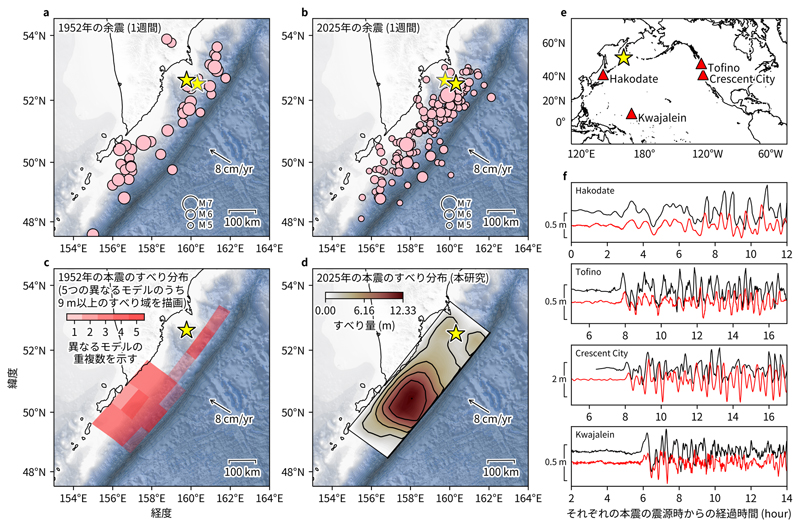
1952年と2025年にカムチャツカ沖で起きた2つのM9級巨大地震が、どれほど似た場所で起きたのかを示した。
<関連情報>
- https://www.kyoto-u.ac.jp/ja/research-news/2025-12-09-2
- https://www.kyoto-u.ac.jp/sites/default/files/2025-12/web_2512_Fukahata-4bdf800ece6f5cd3a6f552554981e0f3.pdf
- https://seismica.library.mcgill.ca/article/view/2012
巨大地震サイクルの破れ:カムチャツカ M9 級地震の短い再来間隔とオーバーシュート Breaking the Cycle: Short Recurrence and Overshoot of an M9-class Kamchatka Earthquake
Yuji Yagi,Yukitoshi Fukahata,Ryo Okuwaki,Tomohiro Takagawa,Shinji Toda
Seismica Published:2025-11-30
DOI:https://doi.org/10.26443/seismica.v4i2.2012
Abstract
M9-class megathrust earthquakes in subduction zones are generally thought to release slip deficits on the plate interface accumulated over centuries. However, the 2025 Kamchatka earthquake (Mw 8.8-8.9) ruptured nearly the same area as the 1952 Mw 9.0 event, as shown by the aftershock distribution. This unusually short recurrence interval challenges conventional seismic-cycle models. Using a cutting-edge source inversion technique, we analyze seismic data to estimate the spatiotemporal slip-rate evolution of the 2025 event. The results show that the 2025 rupture involved fault slips exceeding 9 m across a broad region from southern Kamchatka to the northern Kuril Islands, which is significantly greater than the plate convergence of about 6 m since 1952, matching the large-slip area of the 1952 event. Slip rates in the large-slip area accelerated twice, probably due to dynamic stress perturbations and complex frictional behaviour, and were followed by low-angle normal-faulting aftershocks suggesting dynamic overshoot. The results indicate that the 2025 earthquake released a substantial amount of the slip deficit that had not been released during the 1952 event. Therefore, the residual strains that remain after a great earthqauke and are not considered in current hazard forecasting can lead to shorter recurrence. This finding offers important clues to how great earthquakes release slip deficits and may help develop more physically based long-term forecasts.