
2025-12-09 京都大学
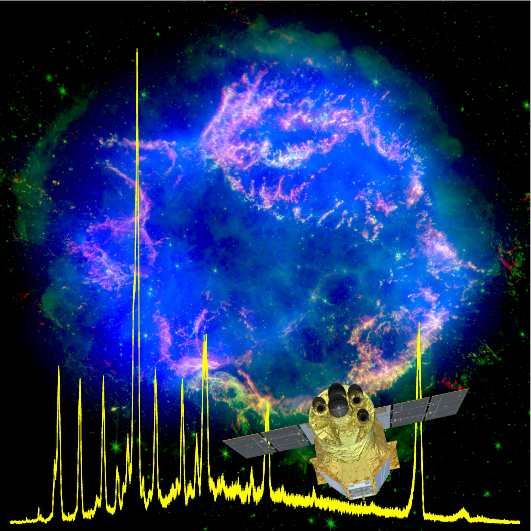
XRISM 衛星による超新星残骸「カシオペア座A」の観測。画像はXRISM/Xtend によって得られたX線画像(青色)とジェームス・ウェッブ宇宙望遠鏡によって得られた画像(赤・緑色)を混合したもの。黄色のX線スペクトルが XRISM/Resolve の観測結果。©明治大学/京都大学/JAXA
<関連情報>
- https://www.kyoto-u.ac.jp/ja/research-news/2025-12-09
- https://www.kyoto-u.ac.jp/sites/default/files/2025-12/web_2512_Matsunaga-f772ed671f5c437614439954c9003f6f.pdf
- https://www.nature.com/articles/s41550-025-02714-4
カシオペヤA超新星残骸における塩素とカリウムの濃縮 Chlorine and potassium enrichment in the Cassiopeia A supernova remnant
XRISM collaboration
Nature Astronomy Published:04 December 2025
DOI:https://doi.org/10.1038/s41550-025-02714-4
Abstract
The elements in the Universe are synthesized primarily in stars and supernovae, where nuclear fusion favours the production of even-Z elements. In contrast, odd-Z elements are less abundant and their yields are highly dependent on detailed stellar physics, making theoretical predictions of their cosmic abundance uncertain. In particular, the origin of odd-Z elements such as phosphorus (P), chlorine (Cl) and potassium (K), which are important for planet formation and life, is poorly understood. While the abundances of these elements in Milky Way stars are close to solar values, supernova explosion models systematically underestimate their production by up to an order of magnitude, indicating that key mechanisms for odd-Z nucleosynthesis are currently missing from theoretical models. Here we report the observation of P, Cl and K in the Cassiopeia A supernova remnant using high-resolution X-ray spectroscopy with X-Ray Imaging and Spectroscopy Mission data, with the detection of K at above the 6σ level being the most significant finding. Supernova explosion models of normal massive stars cannot explain the element abundance pattern, especially the high abundances of Cl and K, while models that include stellar rotation, binary interactions or shell mergers agree closely with the observations. Our observations suggest that such stellar activity plays an important role in supplying these elements to the Universe.


