2025-12-02 カリフォルニア大学バークレー校(UCB)
<関連情報>
- https://www.ssl.berkeley.edu/berkeley-scientists-reveal-ancient-organics/
- https://www.nature.com/articles/s41550-025-02694-5
- https://www.nature.com/articles/s41586-024-08495-6
- https://tiisys.com/blog/2025/01/30/post-160508/
ベンヌの母天体における水以前の極低温化学反応における重合を示唆する窒素と酸素に富む有機物質 Nitrogen- and oxygen-rich organic material indicative of polymerization in pre-aqueous cryochemistry on Bennu’s parent body
Scott A. Sandford,Zack Gainsforth,Michel Nuevo,Matthew A. Marcus,Hans A. Bechtel,Ryan C. Ogliore,Clive Jones,Gerardo Dominguez,Daniel P. Glavin,Jason P. Dworkin,Timothy J. McCoy,Sara S. Russell,Thomas J. Zega,Harold C. Connolly Jr & Dante S. Lauretta
Nature Astronomy Published:02 December 2025
DOI:https://doi.org/10.1038/s41550-025-02694-5
Abstract
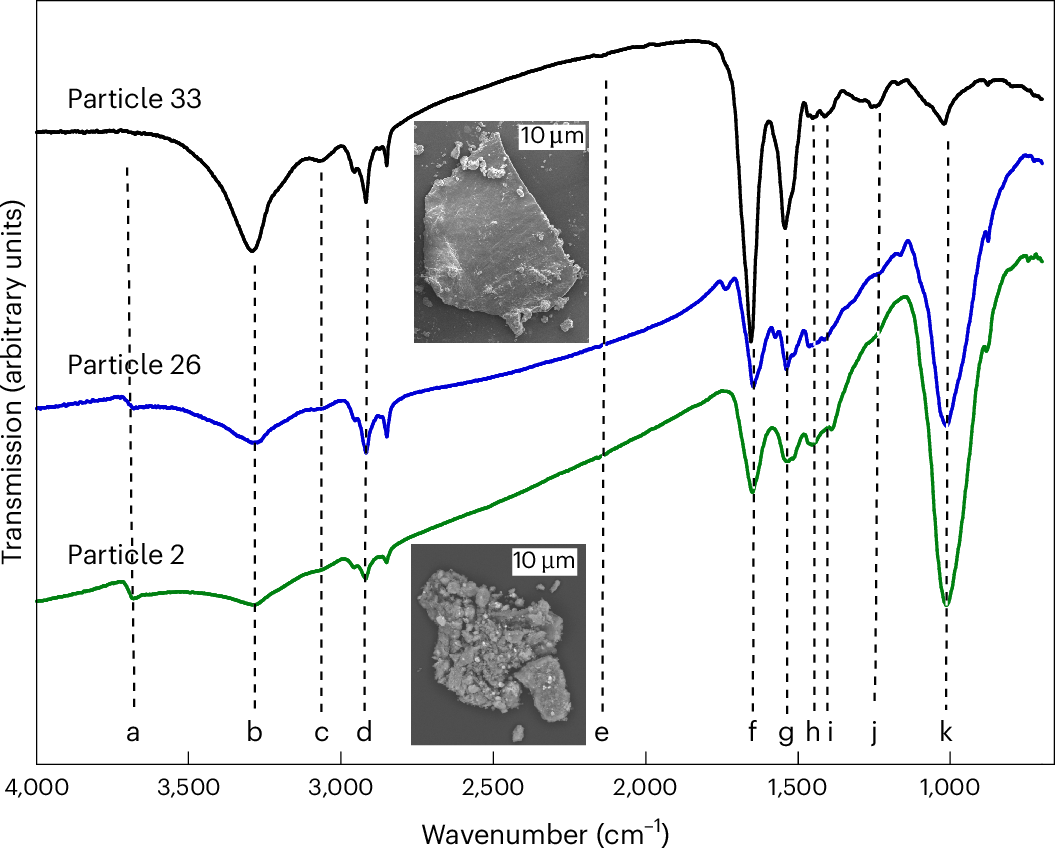
Nitrogen-containing organic compounds play key biological roles, and their identification in primitive astromaterials such as meteorites can shed light on the origin of life. However, meteorites are typically contaminated by uncontrolled exposure to Earth. Here we show that pristine samples returned from asteroid Bennu contain polymeric organics exceptionally rich in nitrogen and oxygen. These polymers contain a variety of functional groups including amines, amides, N-heterocycles, and aliphatic and aromatic hydrocarbons, among others. They are seen in a carbonaceous vein with mineral inclusions and in multilayered organic sheets. Their morphology and composition indicate formation from pre-aqueous N-rich precursors and later modification during aqueous alteration. These findings demonstrate that asteroids like Bennu contain complex nitrogen-rich organic phases formed by pre-aqueous and aqueous processes, and they expand the known inventory of potential prebiotic extraterrestrial compounds.