
2025-12-01 米国国立再生可能エネルギー研究所(NREL)
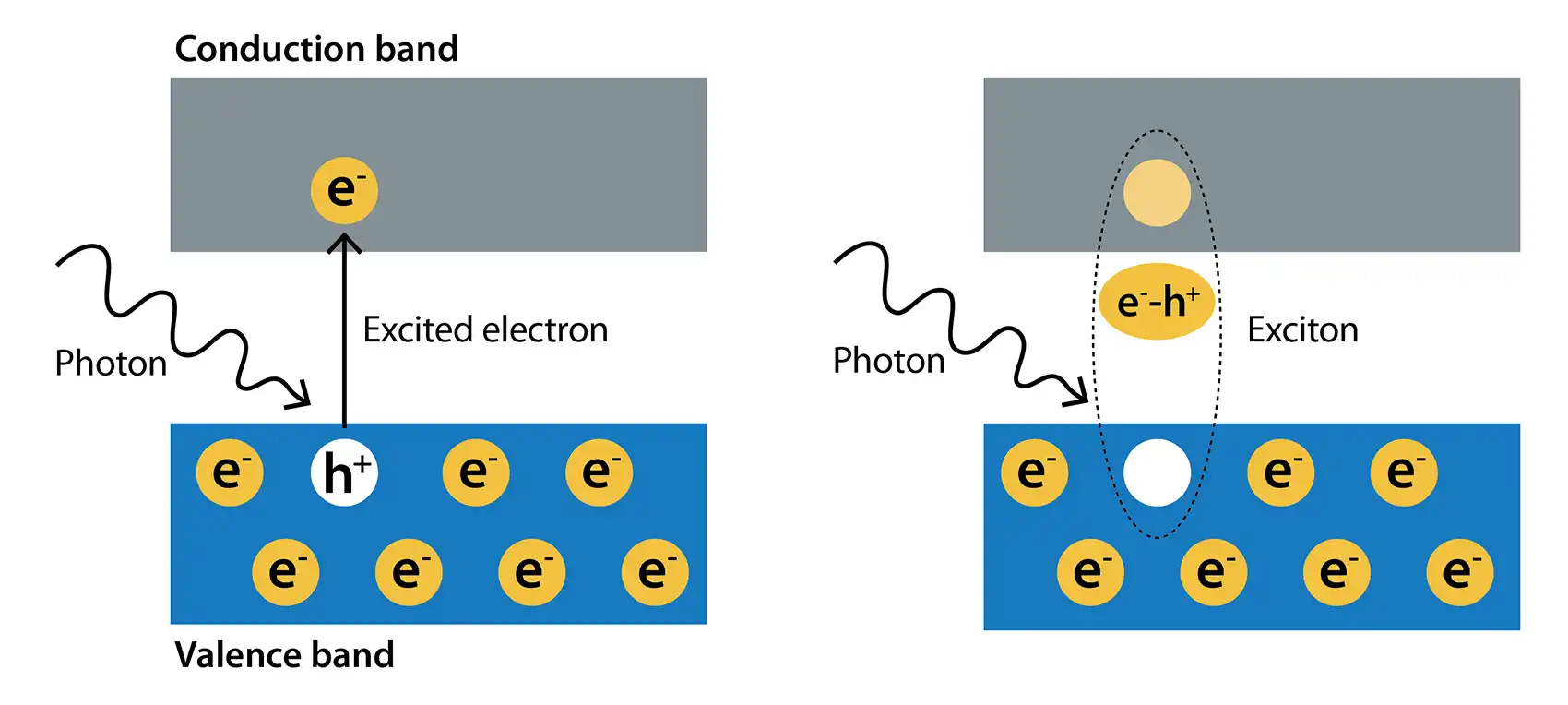
Left: A photon (quantum of light) can be absorbed by an electron (e-) in the valence band and excited to the conduction band, creating a free particle and leaving a hole (h+) behind. Right: In some cases, the same excitation process can form an exciton, when the electron and hole bind together and act as a quasiparticle. Illustration by Katie Carney, NREL
<関連情報>
- https://www.nrel.gov/news/detail/program/2025/scientists-describe-exciton-formation-in-thin-magnetic-crystals-with-potential-for-quantum-computing-or-other-advanced-technologies
- https://www.nature.com/articles/s41563-025-02129-6
層状反強磁性体における磁気的に閉じ込められた表面励起子とバルク励起子 Magnetically confined surface and bulk excitons in a layered antiferromagnet
Yinming Shao,Florian Dirnberger,Siyuan Qiu,Swagata Acharya,Sophia Terres,Evan J. Telford,Dimitar Pashov,Brian S. Y. Kim,Francesco L. Ruta,Daniel G. Chica,Avalon H. Dismukes,Michael E. Ziebel,Yiping Wang,Jeongheon Choe,Youn Jue Bae,Andrew J. Millis,Mikhail I. Katsnelson,Kseniia Mosina,Zdenek Sofer,Rupert Huber,Xiaoyang Zhu,Xavier Roy,Mark van Schilfgaarde,Alexey Chernikov & D. N. Basov
Nature Materials Published:19 February 2025
DOI:https://doi.org/10.1038/s41563-025-02129-6
Abstract
The discovery of two-dimensional van der Waals magnets has greatly expanded our ability to create and control nanoscale quantum phases. A unique capability emerges when a two-dimensional magnet is also a semiconductor that features tightly bound excitons with large oscillator strengths that fundamentally determine the optical response and are tunable with magnetic fields. Here we report a previously unidentified type of optical excitation—a magnetic surface exciton—enabled by the antiferromagnetic spin correlations that confine excitons to the surface of CrSBr. Magnetic surface excitons exhibit stronger Coulomb attraction, leading to a higher binding energy than excitons confined in bulk layers, and profoundly alter the optical response of few-layer crystals. Distinct magnetic confinement of surface and bulk excitons is established by layer- and temperature-dependent exciton reflection spectroscopy and corroborated by ab initio many-body perturbation theory calculations. By quenching interlayer excitonic interactions, the antiferromagnetic order of CrSBr strictly confines the bound electron–hole pairs within the same layer, regardless of the total number of layers. Our work unveils unique confined excitons in a layered antiferromagnet, highlighting magnetic interactions as a vital approach for nanoscale quantum confinement, from few layers to the bulk limit.


