2025-11-27 中国科学院(CAS)
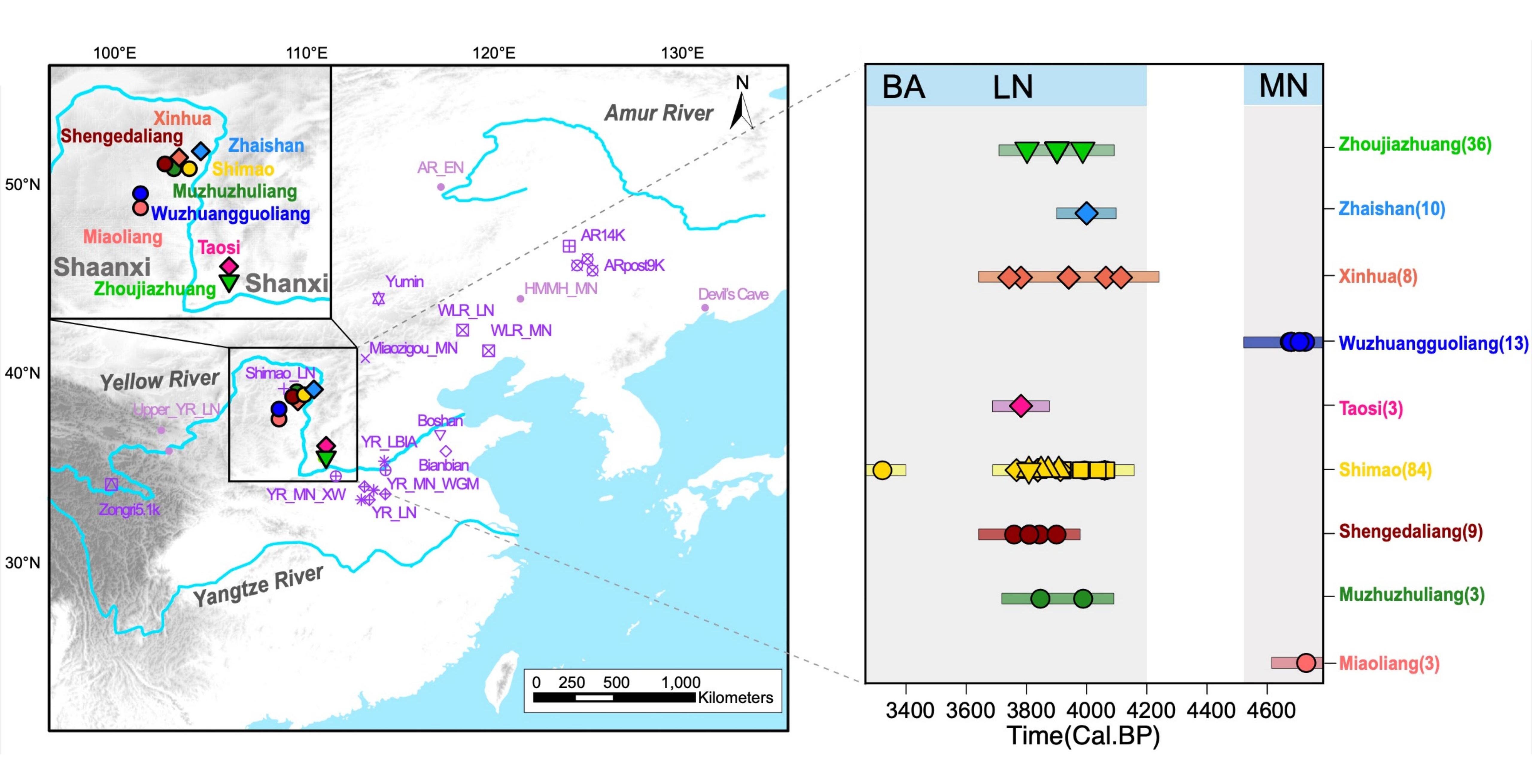
Geographic locations and Temporal distribution of newly sampled archaeological sites. (Image by Prof. FU Qiaomei’s team)
<関連情報>
- https://english.cas.cn/newsroom/research_news/life/202511/t20251127_1134071.shtml
- https://www.nature.com/articles/s41586-025-09799-x
石澳市の古代DNAは新石器時代の中国の親族慣行を記録している Ancient DNA from Shimao city records kinship practices in Neolithic China
Zehui Chen,Jacob D. Gardner,Zhouyong Sun,E. Andrew Bennett,Qian Han,Xuesong Pei,Jing Shao,Han Shi,Wenjun Wang,Jiayang Xue,Fan Bai,Xiangming Dai,Nu He,Xiaoning Guo,Nan Di,Xiaowei Mao,Tianxiang Liu,Peng Cao,Feng Liu,Qingyan Dai,Xiaotian Feng,Wanjing Ping,Xiaohong Wu,Lizhao Zhang,… Qiaomei Fu
Nature Published:26 November 2025
DOI:https://doi.org/10.1038/s41586-025-09799-x
Abstract
The discovery of Shimao city (around 2300–1800 bce1), a premier state-level Neolithic fortified settlement in Shaanxi, China2, played an important role in helping us understand the emergence of socially stratified urban societies. However, key questions remain regarding how ancestry and kinship shaped the hierarchy of this class-based society characterized by human sacrifice. The origin of the founding populations of Shimao and other Loess Plateau settlements, and their interactions within the broader ancestral landscape, have yet to be determined. Here we present, by sequencing 144 ancient genomes from Shimao city and its satellites, pedigrees among tomb owners spanning up to four generations. These findings reveal a predominantly patrilineal descent structure across Shimao communities, and possibly sex-specific sacrificial rituals. We also characterize the population history, revealing that Shimao culture-related populations originated mostly from a Yangshao culture-related population present at least 1,000 years earlier, and the lasting inflow of Yumin-related populations from Inner Mongolia did not interrupt regional genetic continuity. Broader genetic influence from southern mainland ancestry over Shimao culture-related populations supports evidence of rice farming expanding further north than previously expected. Together, these results uncover fine details of the regional peopling and social structure of early state establishment.