2025-11-26 カナダ・ブリティッシュコロンビア大学(UBC)
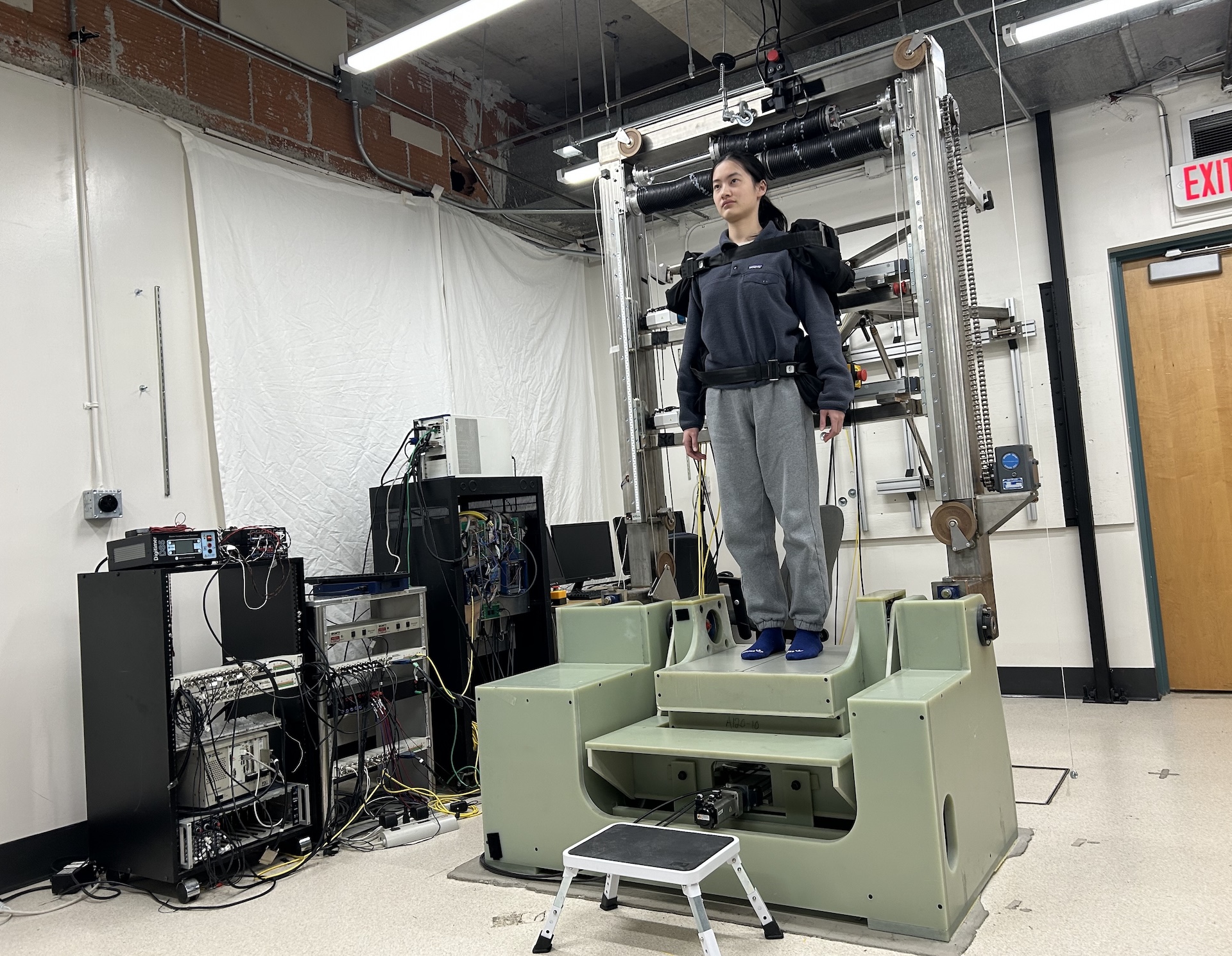
A participant stands in UBC’s robotic balance platform, a research device designed to mimic and alter the forces involved in human standing balance. Credit: Sachi Wickramasinghe
<関連情報>
- https://news.ubc.ca/2025/11/ubc-body-swap-robot-helps-reveal-how-the-brain-keeps-us-upright/
- https://www.science.org/doi/10.1126/scirobotics.adv0496
ロボットによる人間の二足歩行操作は、空間と時間の重なり合う内部表現を明らかにする Robotic manipulation of human bipedalism reveals overlapping internal representations of space and time
Paul Belzner, Patrick A. Forbes, Calvin Kuo, and Jean-Sébastien Blouin
Science Robotics Published:26 Nov 2025
DOI:https://doi.org/10.1126/scirobotics.adv0496
Abstract
Effective control of bipedal postures relies on sensory inputs from the past, which encode dynamic changes in the spatial properties of our movement over time. To uncover how the spatial and temporal properties of an upright posture interact in the perception and control of standing balance, we implemented a robotic virtualization of human body dynamics to systematically alter inertia and viscosity as well as sensorimotor delays in 20 healthy participants. Inertia gains below one or negative viscosity gains led to larger postural oscillations and caused participants to exceed virtual balance limits, mimicking the disruptive effects of an additional 200-millisecond sensorimotor delay. When balancing without delays, participants adjusted their inertia gains to below one and viscosity gains to negative values to match the perception of balancing with an imposed delay. When delays were present, participants increased inertia gains above one and used positive viscosity gains to align their perception with baseline balance. Building on these findings, 10 naïve participants exhibited improved balance stability and reduced the number of instances they exceeded the limits when balancing with a 200-millisecond delay compensated by inertia gains above one and positive viscosity gains. These results underscore the importance of innovative robotic virtualizations of standing balance to reveal the interconnected representations of space and time that underlie the stable perception and control of bipedal balance. Robotic manipulation of body physics offers a transformative approach to understanding how the nervous system processes spatial information over time and could address clinical sensorimotor deficits associated with delays.