2025-11-25 エディンバラ大学
<関連情報>
- https://www.ed.ac.uk/news/ai-tools-forecast-aftershock-risk-in-seconds
- https://link.springer.com/article/10.1186/s40623-025-02241-6
短期データ駆動型時空間地震活動率予測のための深層学習アプローチに向けて Towards a deep learning approach for short-term data-driven spatiotemporal seismicity rate forecasting
Foteini Dervisi,Margarita Segou,Piero Poli,Brian Baptie,Ian Main & Andrew Curtis
Earth, Planets and Space Published:25 November 2025
DOI:https://doi.org/10.1186/s40623-025-02241-6
Abstract
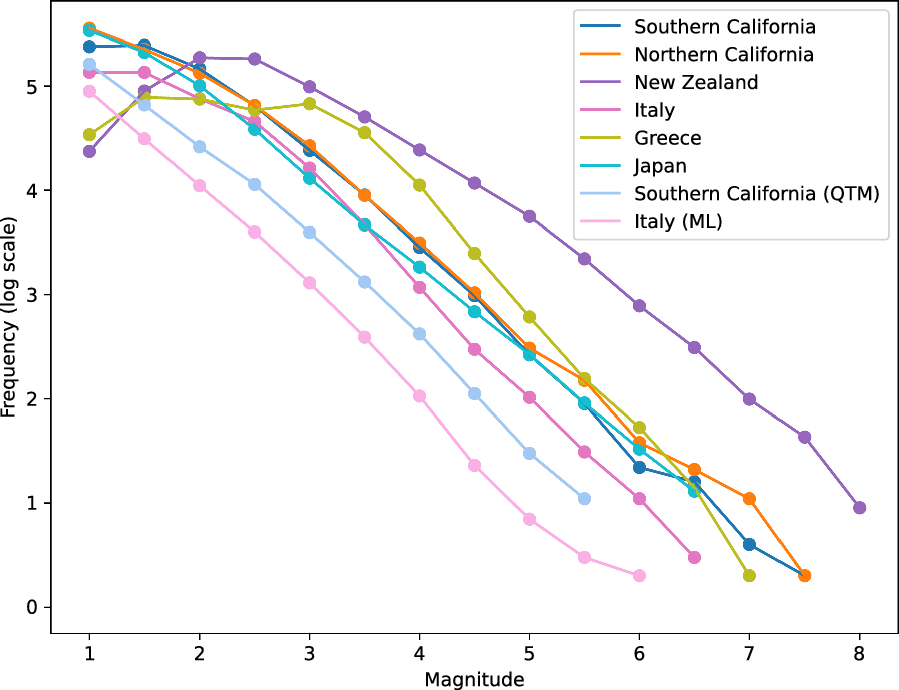
Recent advances in earthquake monitoring have led to the development of methods for the automatic generation of high-resolution catalogues. These catalogues are created at considerably reduced processing times and contain significantly larger volumes of data concerning seismic activity compared to standard catalogues created by human analysts. Disciplinary statistics and physics-based earthquake forecasting models have shown improved performance when rich catalogues are used. The use of high-resolution catalogues paired with machine learning algorithms, which have recently evolved due to the rise in the availability of data and computational power, is therefore a promising approach to uncovering underlying patterns and hidden laws within earthquake sequences. This study focuses on the development of short-term data-driven spatiotemporal seismicity forecasting models with the help of deep learning and tests the hypothesis that deep neural networks can uncover complex patterns within earthquake catalogues. The performance of the forecasting models is assessed using metrics from the data science and earthquake forecasting communities. The results show that deep learning algorithms are a promising solution for generating short-term seismicity forecasts, provided that they are trained on a representative dataset that accurately captures the properties of earthquake sequences. Comparisons of machine learning-based forecasting models with an epidemic-type aftershock sequence benchmark show that both types of models outperform the persistence null hypothesis commonly used as a benchmark in forecasting the behaviour of other types of non-linear systems. Machine learning forecasting models achieve similar performance to that of an epidemic-type aftershock sequence benchmark on the Southern California and Italy test datasets at significantly reduced processing times – a major advantage in applications to short-term operational earthquake forecasting.