2025-11-21 シンガポール国立大学(NUS)
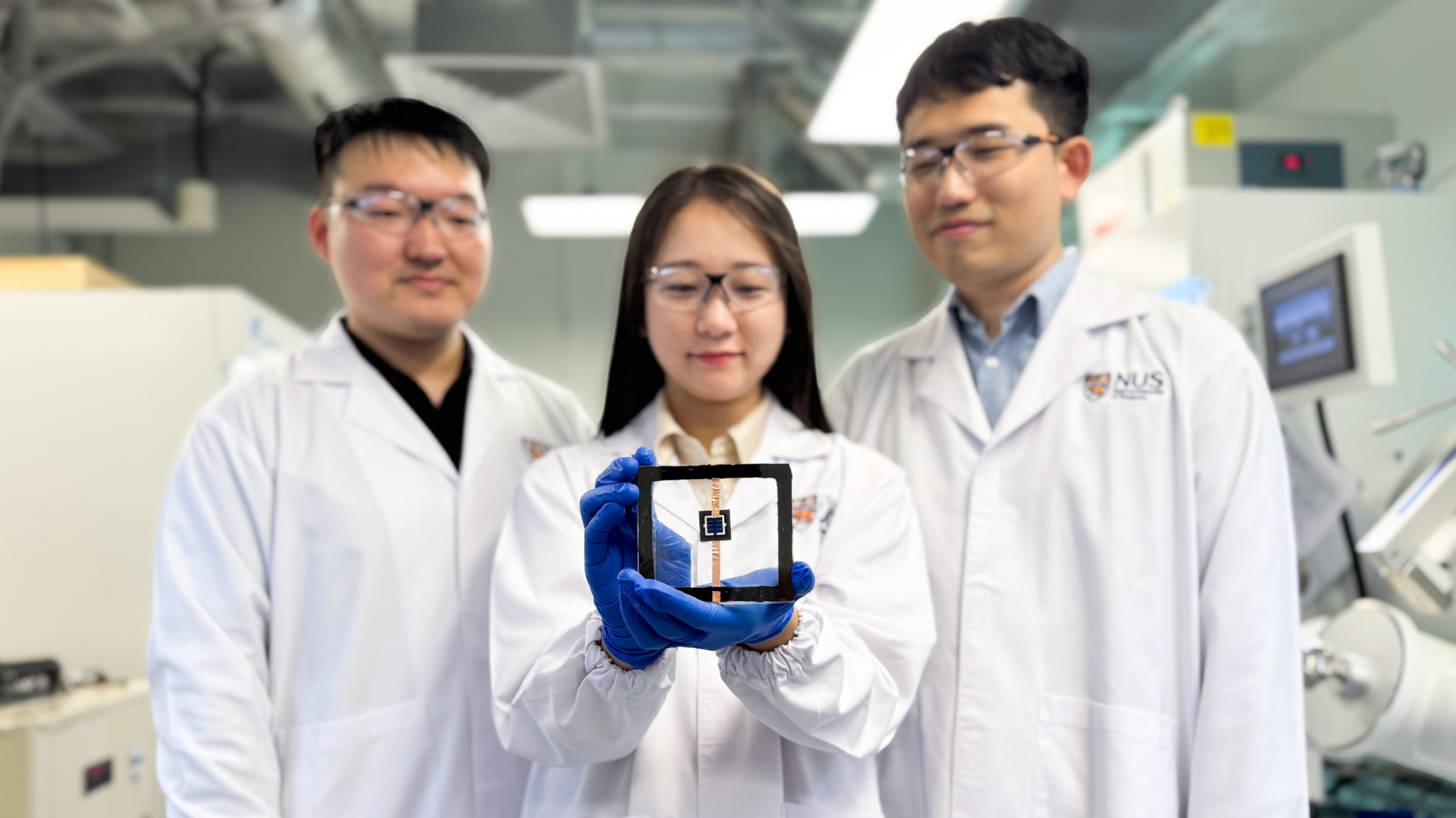
NUS researchers Dr Zhang Boxue (left), Assistant Professor Park Somin (middle) and Assistant Professor Wei Mingyang (right) developed a heat-resistant material to enhance the stability of perovskite/silicon tandem solar cells.
<関連情報>
- https://news.nus.edu.sg/new-molecular-layer-helps-solar-cells-last-longer-under-heat/
- https://www.science.org/doi/10.1126/science.ady6874
ペロブスカイト/シリコンタンデム太陽電池の安定動作のための架橋分子接合 A cross-linked molecular contact for stable operation of perovskite/silicon tandem solar cells
Boxue Zhang, Junsheng Luo, Haomiao Yin, Qing Li, […] , and So Min Park
Science Published:20 Nov 2025
DOI:https://doi.org/10.1126/science.ady6874
Editor’s summary
Polymerizing phosphonic acid hole transporters through Schiff-base chemistry was shown to enhance the operational stability of perovskite-silicon tandem solar cells at elevated temperatures. Zhang et al. reduced the thermal degradation of these self-assembled layers by derivatizing the molecules with primary amines that were cross-linked with aldehyde-functionalized bipyridine molecules. One-square-centimeter tandem solar cells achieved power conversion efficiencies exceeding 34% and lost less than 4% of their initial performance after about 1200 hours of maximum power point tracking at 65°C. —Phil Szuromi
Abstract
Monolithic perovskite/silicon tandem solar cells surpass the power-conversion efficiency limits of single-junction solar cells but face challenges in operational stability. We identified fill factor diminution as a key performance-loss mode in the state-of-the-art tandem architecture. We reveal that widely used hole-selective molecular contacts, which enhance tandem cell performance, undergo thermal degradation that undermines charge transport. At elevated temperatures, the resistance of conventional monomeric contacts increases by about sixfold because of thermal-induced disorder. To stabilize interfacial structures, we introduce in situ synthesized cross-linked molecular contacts based on Schiff base linkages. One-square-centimeter perovskite/silicon tandem solar cells achieved power-conversion efficiencies exceeding 34% (33.61% certified), and three independent devices retained 96.2 ± 1.7% of their initial performance after about 1200-hour maximum power point operation under AM1.5G illumination at 65°C.