2025-11-20 NASA
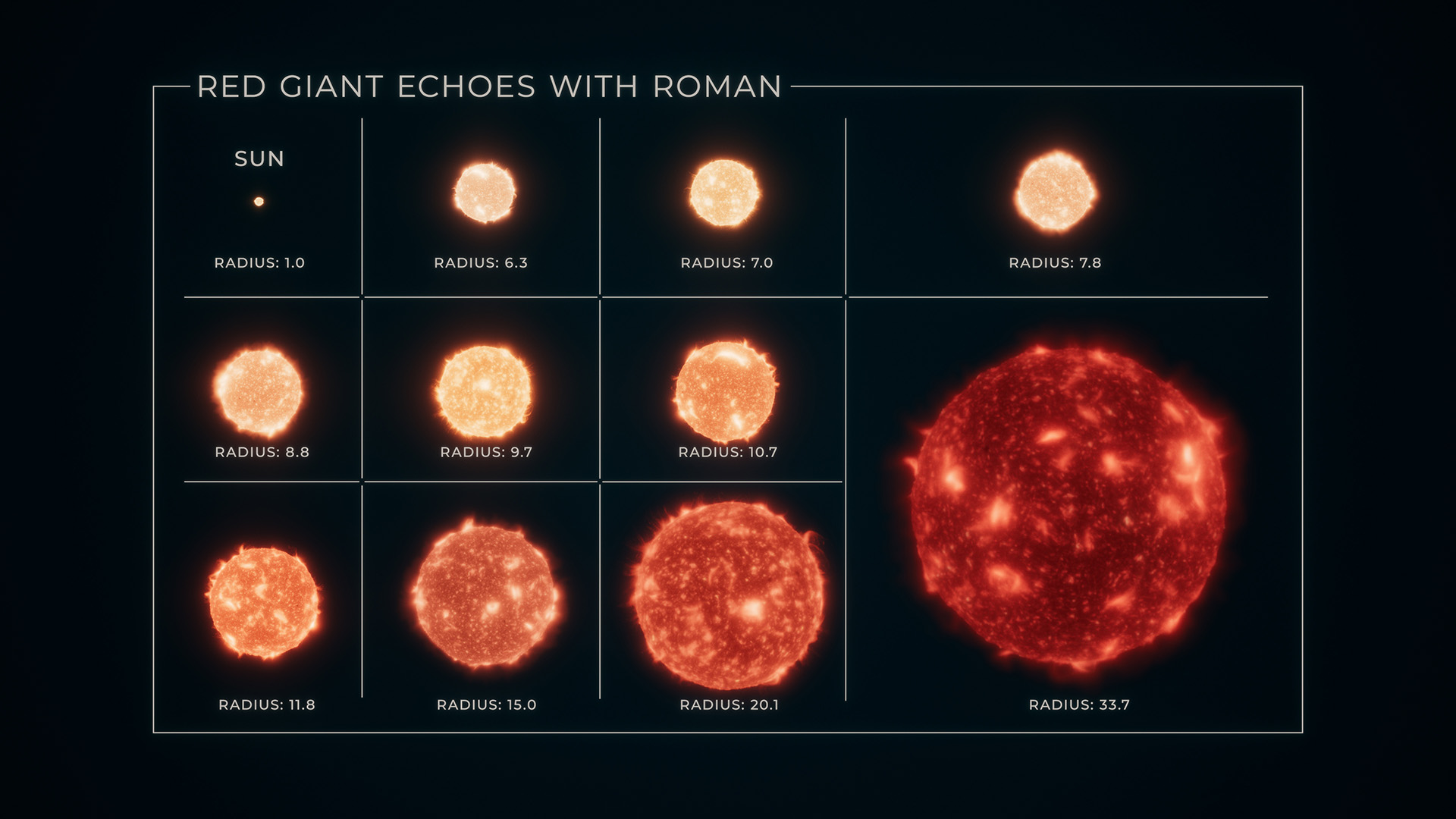
This artist’s concept visualizes the Sun and several red giant stars of varying radii. NASA’s upcoming Nancy Grace Roman Space Telescope will be well suited for studying red giant stars with a method known as asteroseismology. This approach entails studying the changes in stars’ overall brightness, which is caused by their turbulent interiors creating waves and oscillations. With asteroseismic detections, astronomers can learn about stars’ ages, masses, and sizes. Scientists estimate Roman will be able to detect a total of 300,000 red giant stars with this method. This would be the largest sample of its kind ever collected.Credit: NASA, STScI, Ralf Crawford (STScI)
<関連情報>
- https://www.nasa.gov/missions/roman-space-telescope/nasas-roman-could-bring-new-waves-of-information-on-galaxys-stars/
- https://iopscience.iop.org/article/10.3847/1538-4357/adde5b
ローマ銀河バルジ時間領域調査のための恒星地震収量のモデリング Modeling Asteroseismic Yields for the Roman Galactic Bulge Time-domain Survey
Trevor J. Weiss, Noah J. Downing, Marc H. Pinsonneault, Joel C. Zinn, Dennis Stello, Timothy R. Bedding, Kaili Cao, Marc Hon, Claudia Reyes, B. Scott Gaudi,…
The Astrophysical Journal Published 2025 July 8
DOI:10.3847/1538-4357/adde5b
Abstract
The Galactic Bulge Time-Domain Survey (GBTDS) of the Roman Space Telescope will take high-cadence data of the Galactic bulge. We investigate the asteroseismic potential of this survey for red giants. We simulate the detectability of global asteroseismic frequencies,vmax and Δν, by modifying Kepler data to match nominal GBTDS observing strategies, considering different noise models, observing cadences, and detection algorithms. Our baseline case, using conservative assumptions, consistently leads to asteroseismic vmax detection probabilities above 80% for red clump and red giant branch (RGB) stars brighter than the 16th magnitude in Roman’s F146 filter. We then inject these detection probabilities into a Galaxia model of the bulge to estimate asteroseismic yields. For our nominal case, we detect 290,000 stars in total, with 185,000 detections in the bulge. Different assumptions give bulge yields from 135,000 to 349,000 stars. For stars with measured vmax, we find that we can recover Δν in 21%–42% of red clump stars, and 69%–92% of RGB stars. The expected yield and stellar parameter precision we predict for Roman asteroseismology promise to characterize planet-hosting stellar populations and to resolve questions regarding the formation history of the bulge.