2025-11-18 中国科学院(CAS)
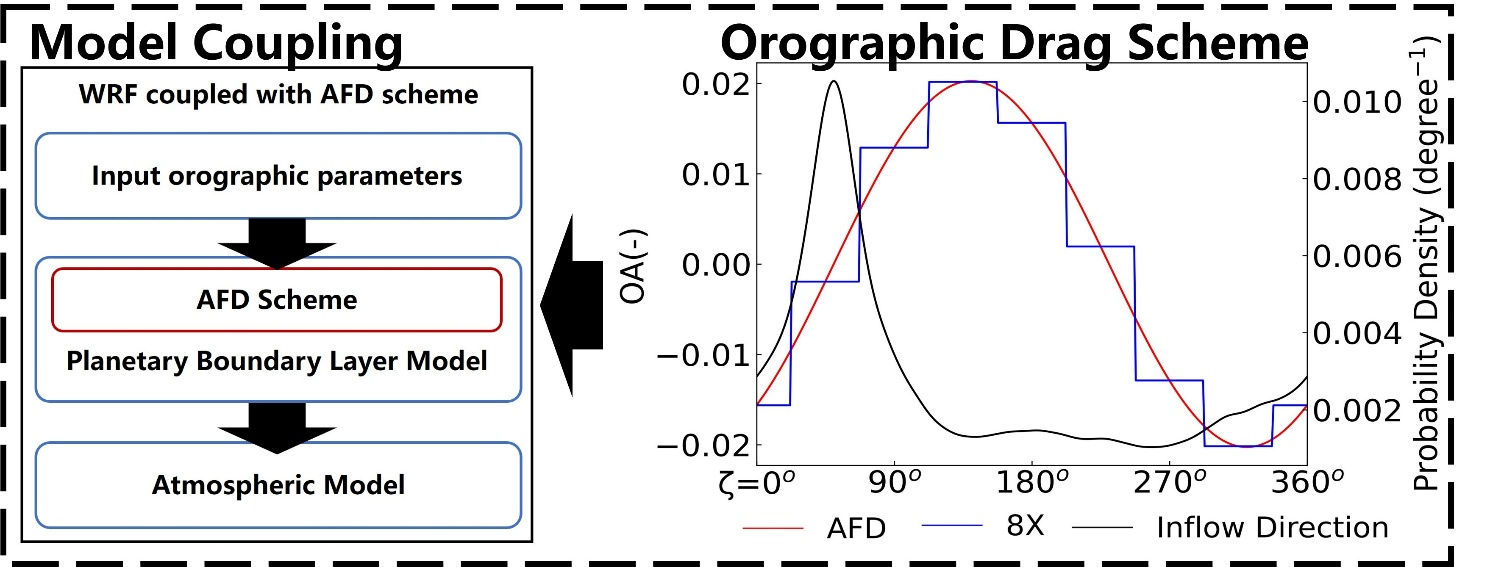
A schematic diagram of the coupling of the orographic drag scheme considering anisotropy within the WRF model framework. (Image by TIAN Yuhang)
<関連情報>
- https://english.cas.cn/newsroom/research_news/earth/202511/t20251120_1132440.shtml
- https://agupubs.onlinelibrary.wiley.com/doi/10.1029/2025JD044517
気象研究予報モデルにおける新開発の地形抵抗スキームの実装 Implementation of the Newly Developed Orographic Drag Scheme in the Weather Research and Forecast Model
Yuhang Tian, Zhenghui Xie, Jinbo Xie, Binghao Jia, Peihua Qin, Ruichao Li, Longhuan Wang, Heng Yan, Yanbin You
Journal of Geophysical Research: Atmospheres Published: 07 November 2025
DOI:https://doi.org/10.1029/2025JD044517
Abstract
A reasonable representation of the complex terrain impacts including orographic anisotropy in numerical models is crucial for improving weather and climate simulations especially in the mountainous region. In this study, we developed the orographic drag scheme that includes orographic anisotropy for all flow directions based on Lambert projection grid and implemented it into the Weather Research and Forecast (WRF) model. We then conducted two monthly simulations for Tibetan Plateau (TP) using the updated WRF model with the new drag scheme and that with orographic anisotropy for eight representative directions (8X) to validate the updated model against station observation and reanalysis data. The new scheme is shown to reduce the root-mean-square-error (RMSE) in the upper-level zonal wind speed (above 50 hPa) by 10%–20% in the north of the TP and by 5%–10% on the northern TP region. This is achieved by better representation of the orographic parameters that perturbed the launching gravity wave momentum flux from the surface and altered its breaking level aloft, thereby impacting the zonal wind vertically. The weakened drag over the west TP raised the breaking level and enhanced zonal wind below 100-hPa while weakened zonal wind above; strengthened drag over the north of TP lowered the breaking level and weakened zonal wind below 50 hpa while enhance it above. The results indicate the importance of explicit orographic anisotropy representation for modeling of regional circulation in mountainous regions.
Plain Language Summary
Accurately representing complex terrain impacts including orographic anisotropy in numerical models is important for weather and climate forecasts. In this study, a new orographic drag scheme that better represents orographic anisotropy is implemented into the Weather Research and Forecast model and its performance is validated via simulations conducted for the Tibetan Plateau. It is shown that the new scheme reduces the biases of stratospheric zonal wind speed presented in the model. This improvement comes from adjusting orographic parameters, which change the launching gravity wave momentum flux from the surface and its breaking level aloft, altering zonal wind vertically. This indicates the importance of improved complex terrain impact in modeling of regional circulation especially in the mountainous region.
Key Points
- A drag scheme considering orographic anisotropy in all flow directions is implemented in the Weather Research and Forecast model
- The new scheme reduced zonal wind model bias over the stratosphere in Tibetan Plateau
- The alleviation is due to explicit representation of orographic anisotropy that altered the momentum deposition in the stratosphere