2025-11-18 カリフォルニア大学アーバイン校(UCI)
<関連情報>
- https://news.uci.edu/2025/11/18/uc-irvine-researchers-link-antarctic-ice-loss-to-storms-at-the-oceans-subsurface/
- https://www.nature.com/articles/s41561-025-01831-z
南極の氷空洞内の海底融解の要因としての海洋サブメソスケール Ocean submesoscales as drivers of submarine melting within Antarctic ice cavities
Mattia Poinelli,Lia Siegelman & Yoshihiro Nakayama
Nature Geoscience Published:18 November 2025
DOI:https://doi.org/10.1038/s41561-025-01831-z
Abstract
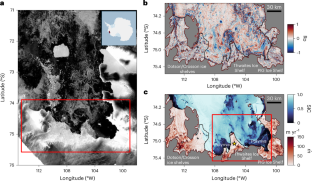
Thwaites and Pine Island glaciers—located in the Amundsen Sea Embayment, West Antarctica—are responsible for more than one-third of the total ice loss from Antarctica. These glaciers are experiencing accelerated retreat due to a combination of complex air–sea-ice processes. The ice cavities—the ocean-filled spaces beneath glaciers where the ice becomes afloat in the form of ice shelves—are particularly vulnerable to warm water intrusions but remain severely understudied due to their remote location and the lack of numerical models capable of resolving small-scale ice–ocean processes. Here we show that ocean submesoscale features (1–10 km size) regularly form in the open ocean, propagate towards Thwaites Glacier, intrude its cavity and melt the ice from below. We use an ice–ocean numerical model at 200-m resolution and observations below the ice to reveal that submesoscale motions are ubiquitous year round in the Amundsen Sea Embayment. Results show that submesoscales account for one-fifth of the total submarine melt variance in the area and highlight a positive feedback loop between submesoscale motions and submarine melting. Following this loop, as future climate warming implies greater ocean-induced melting, these events will become increasingly frequent, with far-reaching implications for ice-shelf stability and global sea-level rise.