2025-11-17 中国科学院(CAS)
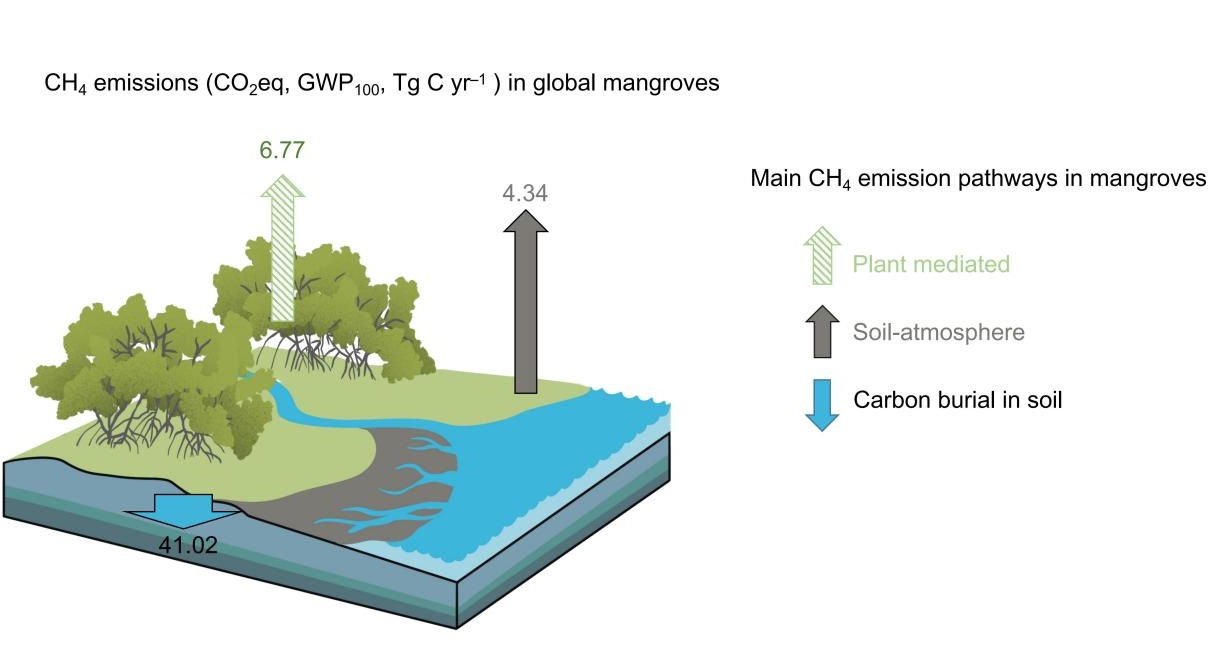
Comparison of global methane emissions from mangrove tree stems and soils. (Image by WANG Faming et al.)
<関連情報>
- https://english.cas.cn/newsroom/research_news/life/202511/t20251114_1115545.shtml
- https://www.nature.com/articles/s41561-025-01848-4
マングローブ堆積物の炭素埋蔵量はマングローブ樹幹からのメタン排出によって相殺される Mangrove sediment carbon burial offset by methane emissions from mangrove tree stems
Guoming Qin,Zhe Lu,Christian Sanders,Jingfan Zhang,Shuchai Gan,Jinge Zhou,Xingyun Huang,Hua He,Mengxiao Yu,Hui Li,Peter I. Macreadie & Faming Wang
Nature Geoscience Published:14 November 2025
DOI:https://doi.org/10.1038/s41561-025-01848-4
Abstract
Mangroves are recognized globally as important blue carbon ecosystems for mitigating climate change due to their remarkable carbon sequestration potential. However, methane emissions from these ecosystems can partially offset their net carbon burial capacity. Although methane oxidation within soils can minimize these emissions, the contribution of methane released directly through mangrove tree stems remains underexplored. Emerging evidence indicates that wetland trees may serve as conduits for soil-derived methane, potentially constituting a poorly quantified component of mangrove carbon cycling. Here we present a global quantification of methane emissions mediated by trees, leveraging field measurements, global datasets and machine learning-driven upscaling. Our analysis reveals that annual stem methane emissions total approximately 730.60 (95% CI: 586.09–876.93) gigagrams per year, offsetting sediment carbon burial by ~16.9%. When combined with soil methane emissions, stem fluxes increase the total methane budget, offsetting approximately 27.5% of blue carbon sequestration. Stem methane emissions were closely related to wood density, soil organic carbon content, salinity and soil methane flux, indicating that emissions originate primarily from mangrove sediments, with higher emissions correlated to lower wood density, lower salinity and greater wood water content. Our findings underscore the need to incorporate stem-mediated fluxes into blue carbon budgets and climate mitigation strategies.