2025-11-12 チャルマース工科大学
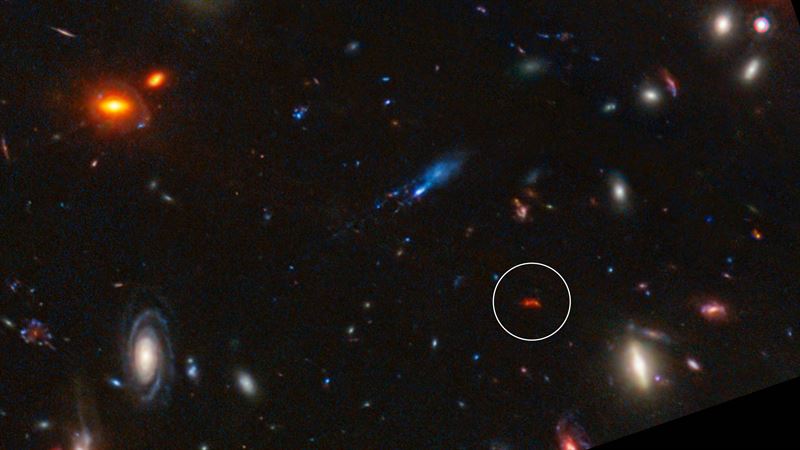
Astronomers have uncovered a previously unknown, extreme kind of star factory by taking the temperature of a distant galaxy using the ALMA telescope. The galaxy is glowing intensely in superheated cosmic dust while forming stars 180 times faster than our own Milky Way. The discovery indicates how galaxies could have grown quickly when the universe was very young, solving a long-standing puzzle for astronomers.
<関連情報>
- https://news.cision.com/chalmers/r/astronomers-discover-a-superheated-star-factory-in-the-early-universe,c4265465
- https://academic.oup.com/mnras/article/544/2/1502/8318242
ビッグバンからわずか6億年後の温かい超高輝度赤外線銀河 A warm ultraluminous infrared galaxy just 600 million years after the big bang
T J L C Bakx, Laura Sommovigo, Yoichi Tamura, Renske Smit, Andrea Ferrara, Hiddo Algera, Susanne Aalto, Duncan Bossion, Stefano Carniani, Clarke Esmerian …
Monthly Notices of the Royal Astronomical Society Published:12 November 2025
DOI:https://doi.org/10.1093/mnras/staf1714
ABSTRACT
We present an Atacama Large Millimeter/submillimeter Array (ALMA) Band 9 continuum detection (3.3σ) of MACS0416_Y1 that confirms the suspected warm dust (91 +62-35K) of this Lyman-Break Galaxy (LBG) at z=8.3 with log10M*/M⦿=9.0±0.1. A modified blackbody fit to the ALMA Bands 3 through 9 data of MACS0416_Y1 finds an intrinsic infrared luminosity of 1.0+1.8-0.6×10¹²L⦿, placing this UV-selected LBG in the regime of Ultra Luminous Infrared Galaxies. Its luminous but modest dust reservoir (1.4+1.3-0.5 ×10⁶M⦿ ) is cospatial to regions with a UV-continuum slopeβUV≈-1.5 as seen by James Webb Space Telescope (JWST) imaging. Although this implies some dust obscuration, the JWST photometry implies less obscured star formation than seen in the complete characterization by ALMA, implying some spatial separation of dust and stars on scales below 200 pc, i.e. smaller than those probed by JWST and ALMA. This source is an extreme example of dust-obscured star formation contributing strongly to the cosmic build-up of stellar mass, which can only be revealed through direct and comprehensive observations in the (sub)mm regime.