2025-11-06 マサチューセッツ工科大学(MIT)
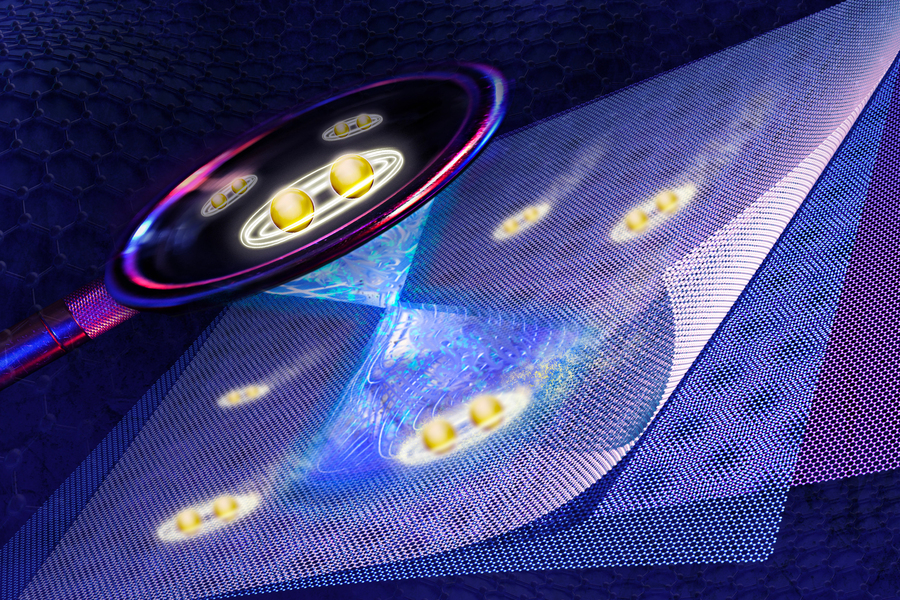
MIT researchers observed clear signatures of unconventional superconductivity in magic-angle twisted trilayer graphene (MATTG). The image illustrates pairs of superconducting electrons (yellow spheres) traveling through MATTG, as the team’s new method (represented by magnifying glass) probes the material’s unconventional superconducting gap (represented by the V-shaped beam).Image: Sampson Wilcox and Emily Theobald, MIT RLE
<関連情報>
- https://news.mit.edu/2025/physicists-observe-evidence-unconventional-superconductivity-graphene-1106
- https://www.science.org/doi/10.1126/science.adv8376
モアレグラフェンにおけるノード超伝導ギャップの実験的証拠 Experimental evidence for nodal superconducting gap in moiré graphene
Jeong Min Park, Shuwen Sun, Kenji Watanabe, Takashi Taniguchi, and Pablo Jarillo-Herrero
Science Published:6 Nov 2025
DOI:https://doi.org/10.1126/science.adv8376
Abstract
Understanding the nature of superconductivity in magic-angle graphene remains challenging. A key difficulty lies in discerning the different energy scales in this strongly interacting system, particularly the superconducting gap. Here, we report simultaneous tunneling spectroscopy and transport measurements of magic-angle twisted trilayer graphene. This approach allows us to identify two coexisting V-shaped tunneling gaps with different energy scales: a distinct low-energy superconducting gap that vanishes at the superconducting critical temperature and magnetic field, and a higher-energy pseudogap. The superconducting tunneling spectra display a linear gap-filling behavior with temperature and magnetic field and exhibit the Volovik effect, consistent with a nodal order parameter. Our work suggests an unconventional nature of the superconducting gap and establishes an experimental framework for multidimensional investigation of tunable quantum materials.