2025-11-06 北海道大学,北海道立総合研究機構,苫小牧工業高等専門学校
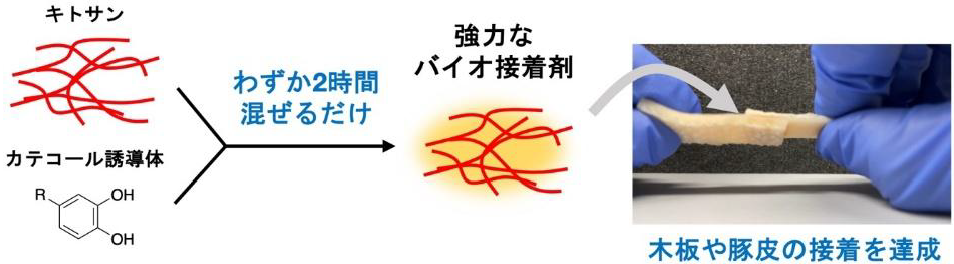
キトサンとカテコール誘導体の単純な混合で強力なバイオ接着剤を製造。わずか2時間撹拌するだけで、手で力一杯引っ張るくらいでは離れないほどの接着力を示した。
<関連情報>
- https://www.hokudai.ac.jp/news/2025/11/post-2113.html
- https://www.hokudai.ac.jp/news/pdf/251106_pr2.pdf
- https://pubs.acs.org/doi/10.1021/acsomega.5c06017
簡便かつ添加剤フリーなキトサン‐カテコール接着剤の合成と木材・皮膚への高強度接着評価 Facile and Additive-Free Synthesis of Chitosan-Catechol Adhesives with Enhanced Adhesive Strength: Performance Evaluation for Wood and Skin Binding
Mariko Kojima,Junki Noda,Shuichiro Seno,Gloria Kamwezi,Yuya Nagaoka,Hiroyuki Kono,Ronny Martinez,and Akira Onoda
ACS Omega Published: October 6, 2025
DOI:https://doi.org/10.1021/acsomega.5c06017
Abstract
Composite materials, which include chitosan and catechol derivatives, are promising bioadhesives that are inspired by natural adhesive biomolecules in mussels. Although adhesives based on the composite of chitosan and catechol have been explored, these require multiple steps for preparation using chemicals such as a coupling reagent and purification. Here, novel adhesive composite materials with high adhesive properties are prepared by additive-free mixing of chitosan (CS) and 3,4-dihydroxybenzaldehyde (DB). The resulting CS-catechol (CS-DB) exhibits sufficient adhesion to glue pairs of wood plates and sections of pork skin together with adhesive strengths of 1.50–3.12 and 0.33–0.55 MPa, respectively. CS-DB retains its adhesive strength (0.09–0.13 MPa) even in wet environments. The results of shear tests of CS-DB samples prepared from CS with different average molecular weights of polymerization (MW) and degrees of deacetylation (DDA) indicate that the adhesion to the surface of wood plates is strongly affected by the MW and that adhesion to the surface of pork skin is more affected by DDA. In addition, CS-DB samples have significantly improved properties in abrasion resistance when used as a coating on wood plates in a Taber abrasion test.