2025-11-03 中国科学院(CAS)
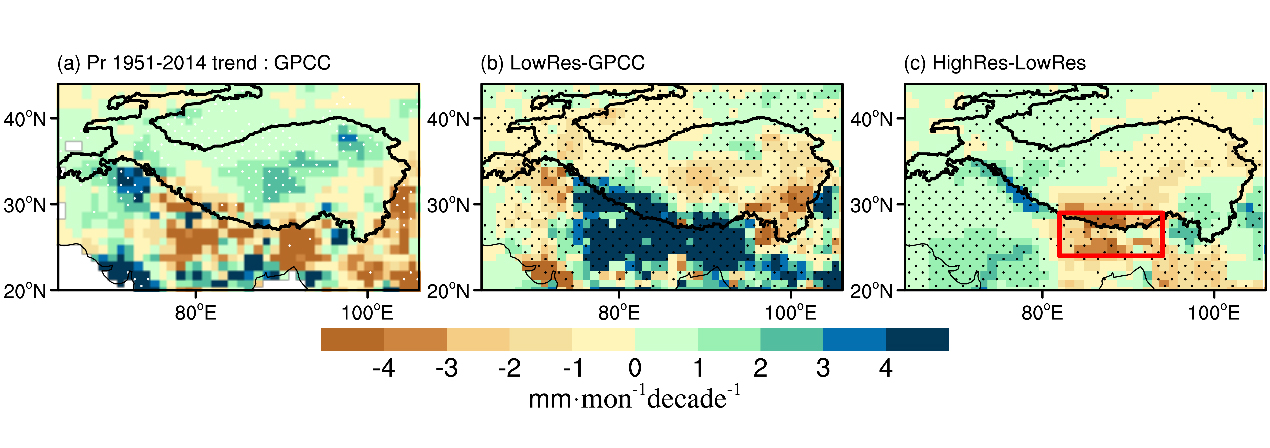
Linear trends of summer precipitation during 1951–2014 in HMA (units: mm·month⁻¹·decade⁻¹). (Image by Prof. ZHOU Tianjun’s team)
<関連情報>
- https://english.cas.cn/newsroom/research_news/earth/202511/t20251103_1095483.shtml
- https://journals.ametsoc.org/view/journals/clim/38/22/JCLI-D-25-0099.1.xml
高解像度CMIP6モデルはアジア南部高山地域の降水傾向をより正確に捉える High-Resolution CMIP6 Models Better Capture Southern High Mountain Asia Precipitation Trends
Lan Li,Tianjun Zhou,Jie Jiang,Xialong Chen,Shuai Hu,Zikun Ren, andLinqiang He
Journal of Climate Published:15 Oct 2025
DOI:https://doi.org/10.1175/JCLI-D-25-0099.1
Abstract
Summer precipitation over High Mountain Asia (HMA) has exhibited a dipolar trend over the past 50 years, with a drying trend in the southern HMA. Understanding the underlying mechanisms relies heavily on climate models. However, the impact and mechanisms of model resolution on the simulation of long-term precipitation trends over this complex terrain area of HMA remain underexplored. In this study, we use six pairs of CMIP6 models with high- and low-resolution historical climate simulations to investigate the resolution-dependent differences in the long-term trends of summer precipitation from 1951 to 2014. The results show that compared to low-resolution models, the simulations from high-resolution models are closer to observations, with the largest improvement in the southern margin of the HMA and surrounding areas (STP), where the wet bias is reduced by approximately 65%. We explore the mechanism behind the reduction in wet bias by conducting moisture budget and moist static energy budget analyses. We find that the reduced wet biases result from an anticyclonic circulation over the northern Bay of Bengal, which transports dry air to the STP and suppresses local convection over there. The anticyclone is a Rossby wave response to negative heating associated with suppressed precipitation over the Maritime Continent and the South China Sea, which is further traced to improved simulation of the central-warm tropical Indian Ocean sea surface temperature (SST) pattern by high-resolution models. We emphasize the remote Indian Ocean forcing instead of local orographic forcing in improving the simulation of long-term precipitation changes in the southern HMA.