2025-11-05 名古屋大学
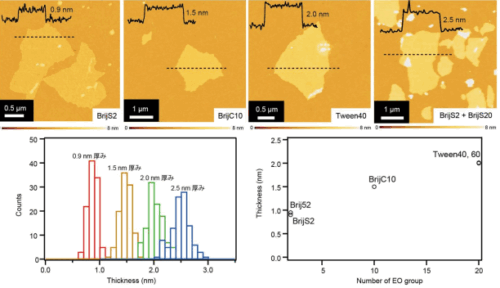
図1 (上)アモルファスシリカナノシートの原子間力顕微鏡象(AFM)注6)と(左下)それぞれの厚みの分布と(右下)PEO数と厚みの関係
<関連情報>
- https://www.nagoya-u.ac.jp/researchinfo/result/2025/11/post-896.html
- https://www.nagoya-u.ac.jp/researchinfo/result/upload_images/20251105_imass.pdf
- https://pubs.acs.org/doi/10.1021/acsnano.5c13829
界面活性剤テンプレートを用いたサブナノメートル厚の自立型非層状ナノシートの作製 Surfactant Templating for the Subnanometer Thickness Engineering of Free-Standing Nonlayered Nanosheets
Eisuke Yamamoto,Yuma Takezaki,Renjiro Hara,Makoto Kobayashi,Ruben Canton Vitoria,Zixiao Shi,David A. Muller,Thomas E. Mallouk,and Minoru Osada
ACS Nano Published: November 4, 2025
DOI:https://doi.org/10.1021/acsnano.5c13829
Abstract
The precise control of thickness at the subnanometer scale is essential for tuning the properties of two-dimensional (2D) nanosheets. However, the thickness control of free-standing nanosheets composed of nonlayered compounds remains a fundamental challenge. Here, we report a solid-state surfactant templating strategy for synthesizing free-standing amorphous siloxane nanosheets with subnanometer thickness precision. By tailoring the length of ethylene oxide chains of the surfactant, we reproducibly obtained nanosheets with precisely defined thicknesses of 0.9, 1.5, 2.0, and 2.5 nm, while also enabling the incorporation of organofunctional groups into their frameworks. The resulting nanosheets exhibit thickness uniformity and high colloidal stability, enabling the formation of densely packed large-area films suitable for the systematic investigation of the properties, such as band gaps and breakdown strengths. We found that amorphous silica nanosheets showed exceptionally low overpotentials for the water dissociation reaction with a clear thickness dependence despite amorphous silica being widely regarded as a poor catalyst.