2025-11-05 韓国基礎科学研究院(IBS)
Web要約 の発言:
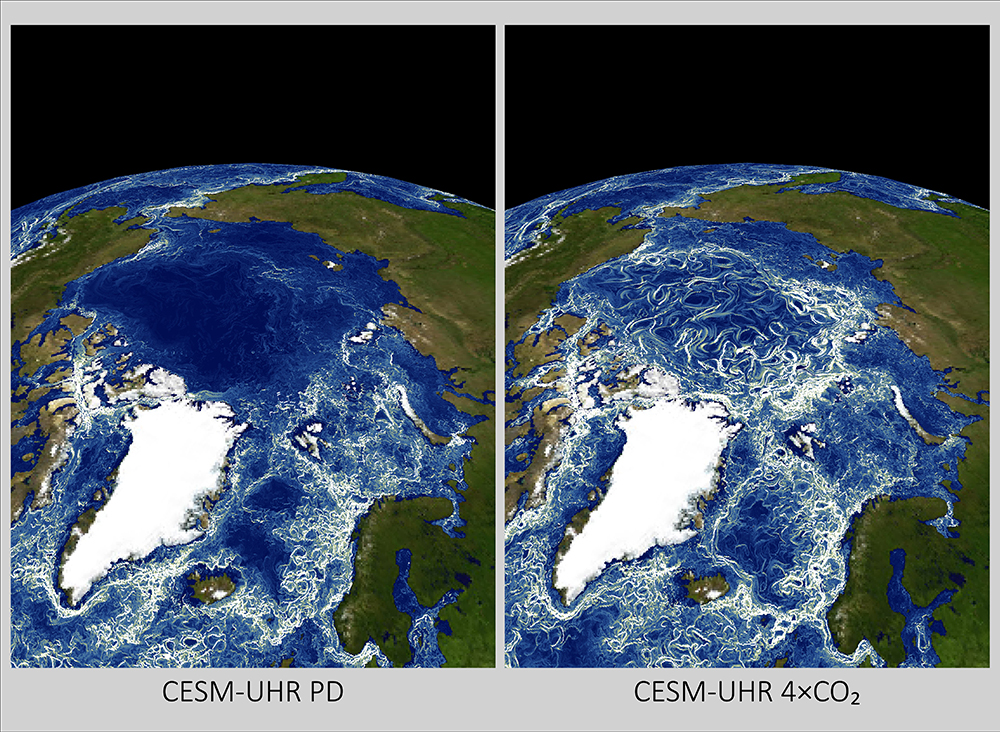
Figure 1. Comparison of Arctic Ocean FSLE snapshots from the two simulations during March. Brighter regions (high FSLE) indicate more vigorous horizontal stirring. Left panel: present-day conditions; right panel: future conditions representing a quadrupling of atmospheric CO2. Basemap credit: NASA Blue Marble. Figure credit: YI Gyuseok.
<関連情報>
- https://www.ibs.re.kr/cop/bbs/BBSMSTR_000000000738/selectBoardArticle.do?nttId=26257&pageIndex=1&searchCnd=&searchWrd=
- https://www.nature.com/articles/s41558-025-02471-2
海氷の減少により極地海洋における中規模水平擾乱が今後激化 Future mesoscale horizontal stirring in polar oceans intensified by sea ice decline
Gyuseok Yi,June-Yi Lee,Eun Young Kwon,Sun-Seon Lee,Myeong-Hyeon Kim,Wonsun Park,Karl Stein & Axel Timmermann
Nature Climate Change Published:05 November 2025
DOI:https://doi.org/10.1038/s41558-025-02471-2
Abstract
Mesoscale horizontal stirring (MHS) is ubiquitous in the oceans, influencing heat and carbon transport, phytoplankton blooms and fish larvae dispersal. The current generation of Earth system models lacks sufficient resolution to properly resolve MHS-relevant small-scale phenomena, such as oceanic mesoscale eddies, leaving it largely unknown how MHS will change in response to greenhouse warming. Here we determine how CO2 doubling and quadrupling will change the surface MHS statistics in Community Earth System Model simulations with 1/10-degree ocean resolution. MHS is analysed using the finite-size Lyapunov exponent, a Lagrangian diagnostic that measures the separation of close trajectories. Projected increases in MHS are expected in the Arctic Ocean and coastal Antarctic regions, driven by enhanced time-mean ocean flow and turbulence which predominantly result from sea ice reduction. The enhanced horizontal stirring in polar oceans implies substantial yet uncertain consequences for tracer transport, nutrient supply and ecosystems under higher CO2 conditions.