2025-11-04 カリフォルニア工科大学(Caltech)

This artist’s concept depicts a supermassive black hole in the process of shredding a massive star—at least 30 times the mass of our Sun—to pieces. Credit: Caltech/R. Hurt (IPAC)
<関連情報>
- https://www.caltech.edu/about/news/black-hole-flare-is-biggest-and-most-distant-seen
- https://www.nature.com/articles/s41550-025-02699-0
超大質量ブラックホールから記録された非常に明るいフレア An extremely luminous flare recorded from a supermassive black hole
Matthew J. Graham,Barry McKernan,K. E. Saavik Ford,Daniel Stern,Matteo Cantiello,Andrew J. Drake,Yuanze Ding,Mansi Kasliwal,Mike Koss,Raffaella Margutti,Sam Rose,Jean Somalwar,Phil Wiseman,S. G. Djorgovski,Patrik M. Veres,Eric C. Bellm,Tracy X. Chen,Steven L. Groom,Shrinivas R. Kulkarni & Ashish Mahabal
Nature Astronomy Published:04 November 2025
DOI:https://doi.org/10.1038/s41550-025-02699-0
Abstract
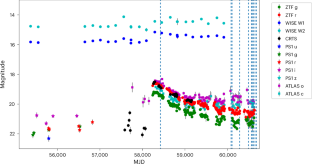
Since their discovery more than 60 years ago, accreting supermassive black holes in active galactic nuclei (AGN) have been recognized as highly variable sources, requiring an extremely compact, dynamic environment. Their variability is related to several phenomena, including changing accretion rates, temperature changes, foreground absorbers and structural changes to the accretion disk. Spurred by a new generation of time-domain surveys, the extremes of black hole variability are now being probed. Here we describe the discovery of an extreme flare by the AGN J224554.84+374326.5, which brightened by more than a factor of 40 in 2018. The source has slowly faded since then. The total emitted ultraviolet and optical energy to date is ~1054 erg, which represents the complete conversion of approximately one solar mass into electromagnetic radiation. This flare is 30 times more powerful than the previous most powerful AGN transient. Very few physical events in the Universe can liberate this much electromagnetic energy. We discuss potential mechanisms, including the tidal disruption of a high-mass star (>30 M⊙), gravitational lensing of an AGN flare or supernova, or a supermassive (pair-instability) supernova in the accretion disk of an AGN. We favour the tidal disruption of a massive star in a prograde orbit in an AGN disk.